
Caring for a Parent Who Is Bedridden or Has Lost Most of Their Mobility
There is usually no single day on which it happens. A stroke, a broken hip, a long illness, or simply a slow decline, and then one week you realise your mother has not been out of that room in a fortnight and is not going to be.
It is a different job from the one the family has been doing until now, and almost nobody is shown how to do it.

Caring for a bedridden parent at home comes down to five things: moving them regularly so their skin does not break down, moving them in a way that does not injure you, keeping their chest, bowels and joints working, getting the right bed and mattress, and protecting their dignity while all of that happens. Skin is the one that catches families out, because a pressure sore can begin in two hours and takes months to heal.
The skin is what will catch you out
Of everything on this page, pressure sores are the thing families do not see coming and the thing that causes the most avoidable suffering. They start where bone sits close to skin and the body's own weight cuts off the blood supply: the heels first, then the base of the spine and the buttocks, then hips, ankles, elbows, shoulder blades and the back of the head.
Two facts explain why this matters more than it sounds. One can begin after about two hours of unrelieved pressure. And once the skin has broken, healing is measured in months, not days.
The earliest sign is a patch of skin that has changed colour and stays changed. Press it gently with a finger. Healthy skin goes pale and then colours again within a few seconds. Skin that does not go pale under your finger is already in trouble, and that is the moment to act rather than the moment to watch. The area may also feel warmer, cooler, firmer or softer than the skin around it, and it may be tender. On darker skin the colour change is much harder to see, so touch matters more than looking.
What actually prevents them:
Change position regularly. At a minimum every four hours, and every two to three is the better habit at home. Alternate between the back and each side, and never leave somebody in one position overnight because everybody is asleep.
Get the heels off the bed. The most overlooked item on any list. A pillow placed lengthways under the calves so the heels float clear of the mattress removes the single highest-risk pressure point in about four seconds.
Look at the skin properly once a day. Not a glance. Heels, base of the spine, hips and elbows, in good light, at the same time each day so it becomes a habit rather than a decision.
Keep the skin clean and dry. Moisture from sweat or incontinence makes skin fragile. A barrier cream protects it. Talcum powder does not.
Do not rub or massage a red area. Old advice, now known to make the damage worse. Relieve the pressure instead.
Smooth sheets, nothing under the body. A rucked sheet or a forgotten remote control will do real damage over a few hours.
Food and fluid. Skin needs protein and water to repair itself. Somebody eating and drinking very little will break down faster and heal slower.
If you find an area that does not go pale under your finger, or any broken skin at all, that is a reason to speak to a doctor or nurse this week rather than to try to manage it at home.
Press a reddened patch of skin gently with a finger. If it does not go pale, the damage has already started. Relieve the pressure, do not rub it, and get it looked at this week.
Moving somebody without injuring yourself
This is the part families get hurt doing, and it is almost always the daughter or the housekeeper who ends up with the back injury. A carer who cannot work is no use to anybody, so this is not a secondary concern.
Three rules cover most of it. Never lift under the arms, which hurts the shoulders and gives you no control. Never let somebody grab your neck. And never try to catch somebody who is going down, because you will both end up on the floor and one of you will be worse off.
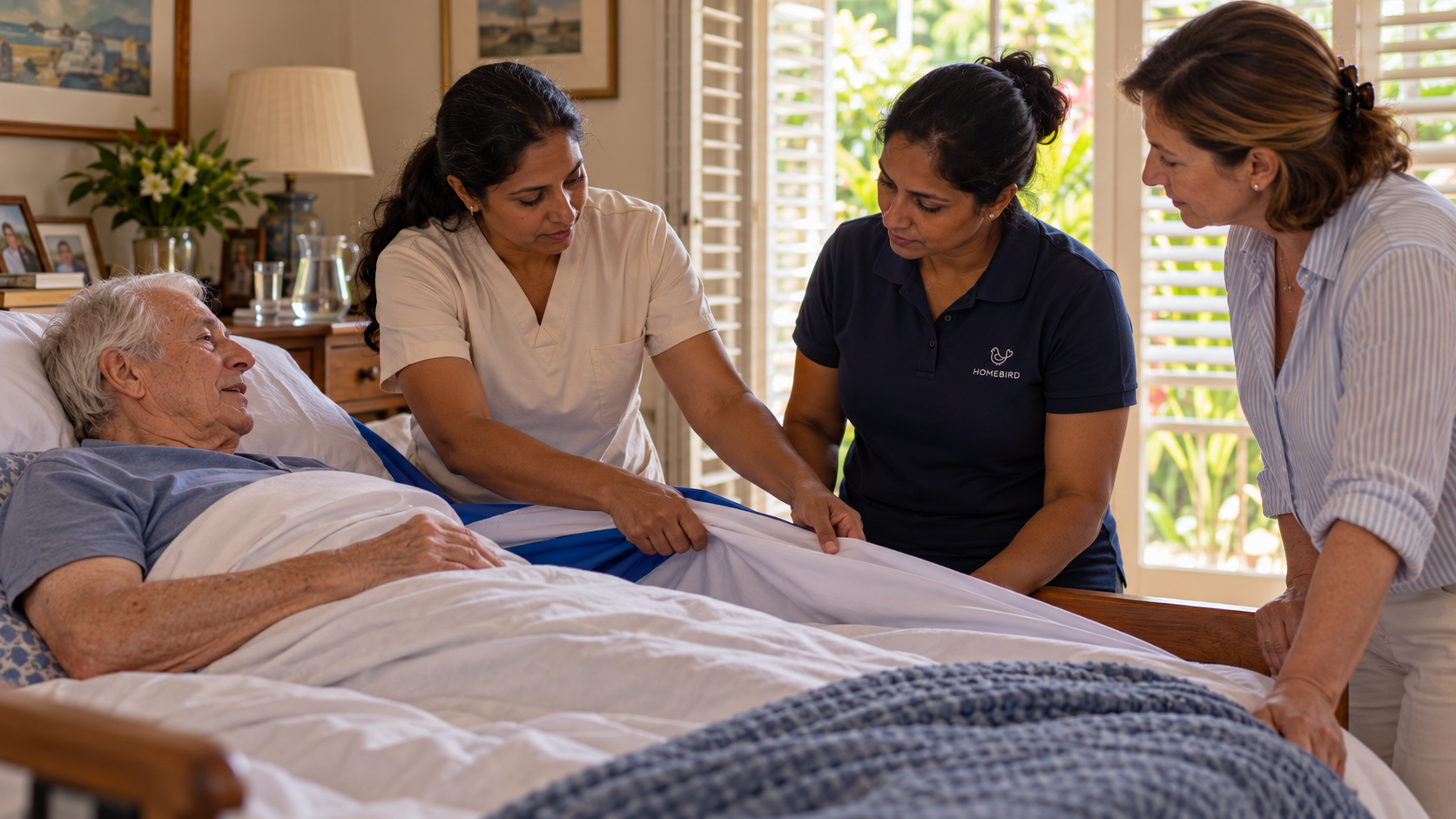
What to do instead. Raise the bed to your hip height if it adjusts, so you are not bending. Stand close, feet apart, bend your knees and keep your back straight. Count out loud so you and the person move on the same beat. Work in twos wherever possible. And buy a slide sheet, which costs very little, takes a week to get used to, and makes turning somebody in bed a matter of sliding rather than lifting.
The best money available in this whole subject is a single session with a physiotherapist, in the house, showing whoever does the daily care how to turn, sit up and transfer this particular person in this particular bed. One appointment. It prevents injuries, it is far more useful than any video, and almost nobody arranges it.
Four things that go wrong when the body stops moving
The chest. Lying flat lets the bases of the lungs fill and makes a chest infection much more likely. Sitting upright for meals and for a good part of the day, and encouraging a few deep breaths and a cough several times a day, does more than it sounds like it should.
The bowels. Constipation is close to universal in somebody who is not moving, particularly on painkillers, and it causes genuine distress and confusion before anybody thinks to ask about it. Fluid, fruit and fibre first, and a word with the pharmacist early rather than after a week.
The joints. A limb that is never moved gradually stiffens into a position and then will not come back, which makes washing and dressing painful and sometimes impossible. Gentle movement of each joint through its range, daily, prevents it. Get a physiotherapist to show you which movements and how far, because this is one thing worth doing right.
The legs. Still legs raise the risk of a clot. Any new swelling, pain, warmth or redness in one calf, or sudden breathlessness, needs a doctor the same day rather than tomorrow.
What to buy, and what to skip
Worth it. An adjustable bed that raises the head and the whole frame, which protects the back of whoever is caring and lets the person sit up without being hauled. A pressure-relieving mattress, foam or air, which is the single most effective purchase here. A slide sheet. A waterproof mattress protector. An overbed table. A commode or urinal within reach. A small bell or buzzer, because calling out across a house is exhausting and undignified.
Think twice. Bed rails, which prevent some falls and cause others, and which should be a decision taken with a doctor or physiotherapist rather than bought online. Ring or donut cushions, which push pressure outwards onto a ring of skin and are no longer recommended. And a hoist, which is genuinely useful for some situations and dangerous without training, so it comes with instruction or not at all.
Position the bed where there is something to look at. A window, the door to the rest of the house, the garden. It sounds like decoration and it is not. The view from that bed is most of the person's day now.
The part nobody writes about
Everything above is mechanical and all of it can be learned in a week. What is harder is that a man who ran a business and drove himself everywhere now needs help to use a bedpan, and both of you know it.
Small things carry most of the weight here. Say what you are about to do before you do it, every time, rather than arriving and starting. Keep a towel over whatever is not being washed. Knock. Ask about the pillows and the fan and the radio, so that a person who can decide almost nothing is still deciding something. Talk about something other than their body at least once a day.
And the thing most families discover eventually: for the most intimate tasks, a trained person who is not family is frequently easier for everybody. Not because a daughter cannot do it, but because the parent would rather she did not, and will often say so only once somebody else has offered.
It is also worth saying that bedbound is not always permanent. After a stroke or a fracture, with the right physiotherapy and a reason to try, people do get up again. Care given on the assumption that this is the end tends to make it the end. Care given on the assumption that something may come back is better care either way.
When to ring the doctor
Same day, not tomorrow, for any of these.
Any broken skin, or a reddened patch that does not go pale under a finger
New confusion, which in an older person is usually infection rather than the mind
Fever, or a new cough, or breathing that has changed
Swelling, pain, warmth or redness in one calf
No bowel movement for three days, or pain and distress with it
Passing much less urine, or urine that is dark, cloudy or strong smelling
Refusing food and fluid for more than a day
Pain that the current medication is not covering
For anything sudden and severe, breathing difficulty, unresponsiveness or a fall, call SAMU on 114.
Never lift under the arms. Never let them hold your neck. Never try to catch somebody who is already falling. A slide sheet and one physiotherapy session will save somebody's back.
This is not a one-person job
Everything else in this guide can be managed by a determined family. This cannot, and saying otherwise would be dishonest. Somebody has to turn a person in the night. Somebody has to be there at seven in the morning and again at eight at night. Nobody does that alone for months without their own health going.
So treat it as a rota rather than a vocation. Write down every task and every hour, decide who covers what, and include the nights and the weekends rather than assuming they will sort themselves out. Then look honestly at the gaps, because the gaps are where it breaks.
Where to start this week
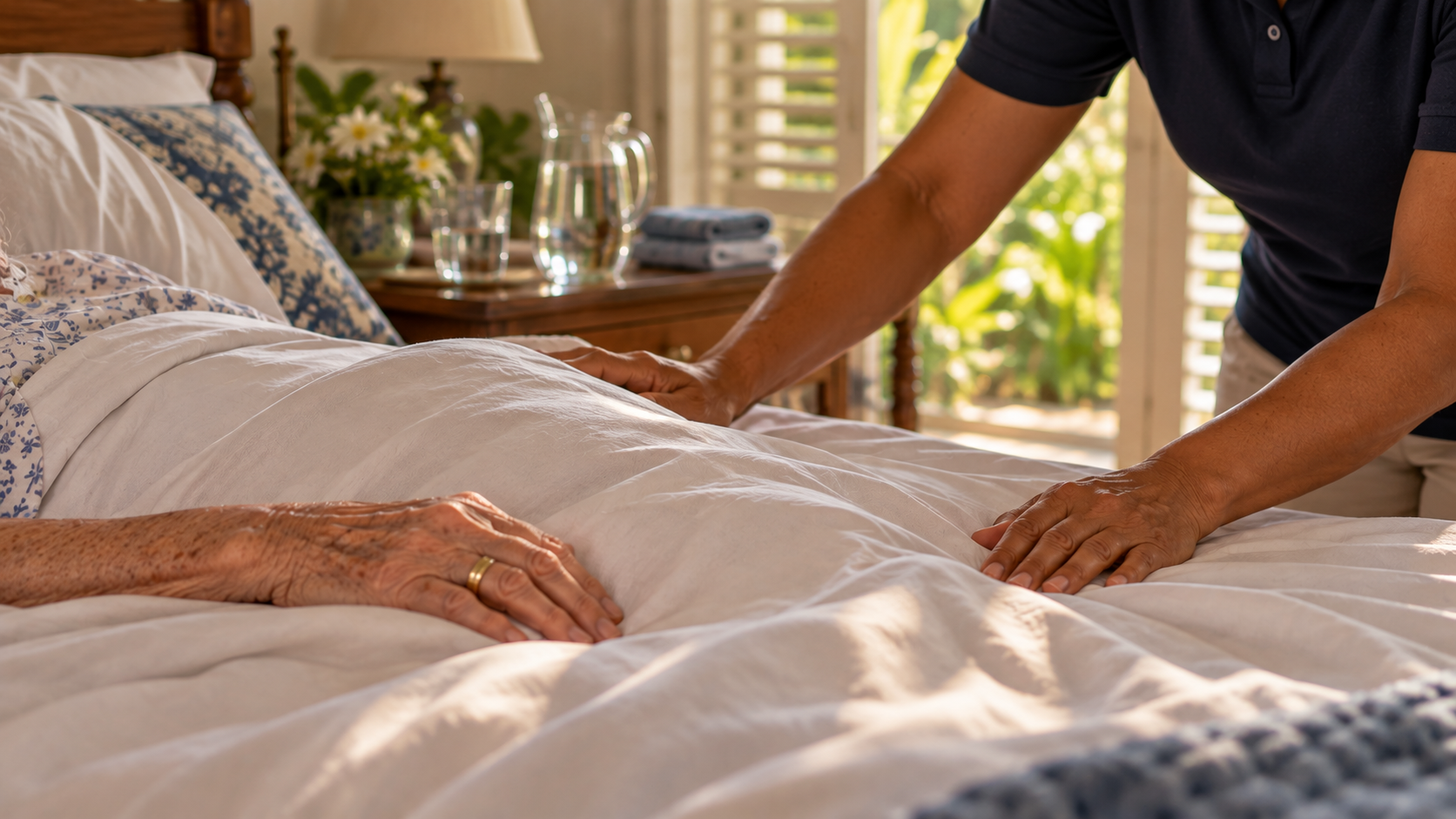
Put a pillow under her calves so her heels are off the mattress, today. Order a pressure-relieving mattress and a slide sheet. Book one physiotherapy visit to the house for turning, transfers and joint movement. Agree a repositioning routine that covers the night, and write it on a sheet of paper by the bed so there is no doubt about who did what and when. Then look at the skin properly, once a day, at the same time.
The first four of those can be done before the weekend, and together they remove most of the risk.
Our free printable daily care log is built for exactly this: one line a day recording turns, food, fluid and anything that looked different. Download the family tools.
Common questions
How often should a bedridden person be turned?
At least every four hours, and every two to three hours is the safer habit at home, including overnight. The interval should be shorter if the skin is already showing redness, and a pressure-relieving mattress reduces the risk but does not replace turning.
What are the first signs of a bedsore?
A patch of skin that has changed colour and does not go pale when you press it gently with a finger. It may also feel warmer, cooler, firmer or softer than the skin around it, or be tender. On darker skin the colour change is hard to see, so touch is more reliable than sight.
What equipment do you need to care for someone bedridden at home?
An adjustable bed, a pressure-relieving mattress, a slide sheet, a waterproof mattress protector, an overbed table, a commode or urinal, and a bell. Bed rails and hoists are useful in some situations but should be decided with a doctor or physiotherapist rather than bought on your own.
Is being bedridden always permanent?
No. After a stroke, a fracture or a long illness, many people regain some mobility with physiotherapy and time. Care given on the assumption that recovery is impossible tends to make it so, which is why joint movement and sitting upright matter from the first week.
This article is part of The Mauritius Guide to Caring for an Elderly Parent at Home, our free guide for families across the island. See the full guide.
Talk to Homebird
Homebird is a professional in-home care agency serving families across Northern Mauritius. Our carers are trained in repositioning, safe transfers, pressure area care and personal care, and this is the situation where a trained pair of hands makes the most difference. No obligation, no pressure.
WhatsApp or call: +230 5811 8335
Email: hello@homebird.mu
Care that feels like family.
This article is for general information and is not a substitute for professional medical or nursing advice. Pressure sores, joint movement, moving and handling and equipment such as bed rails and hoists should all be discussed with a doctor, nurse or physiotherapist who has seen the person concerned. If you find broken skin, speak to a health professional. In an emergency in Mauritius, call SAMU on 114. Guidance on repositioning and skin assessment is drawn from NICE clinical guidance and published clinical sources.