
The first time a daughter in Grand Baie helped her mother wash, neither of them said anything at all. Her mother looked at the wall. It took about twenty minutes and both of them were relieved when it was over, and neither has mentioned it since.
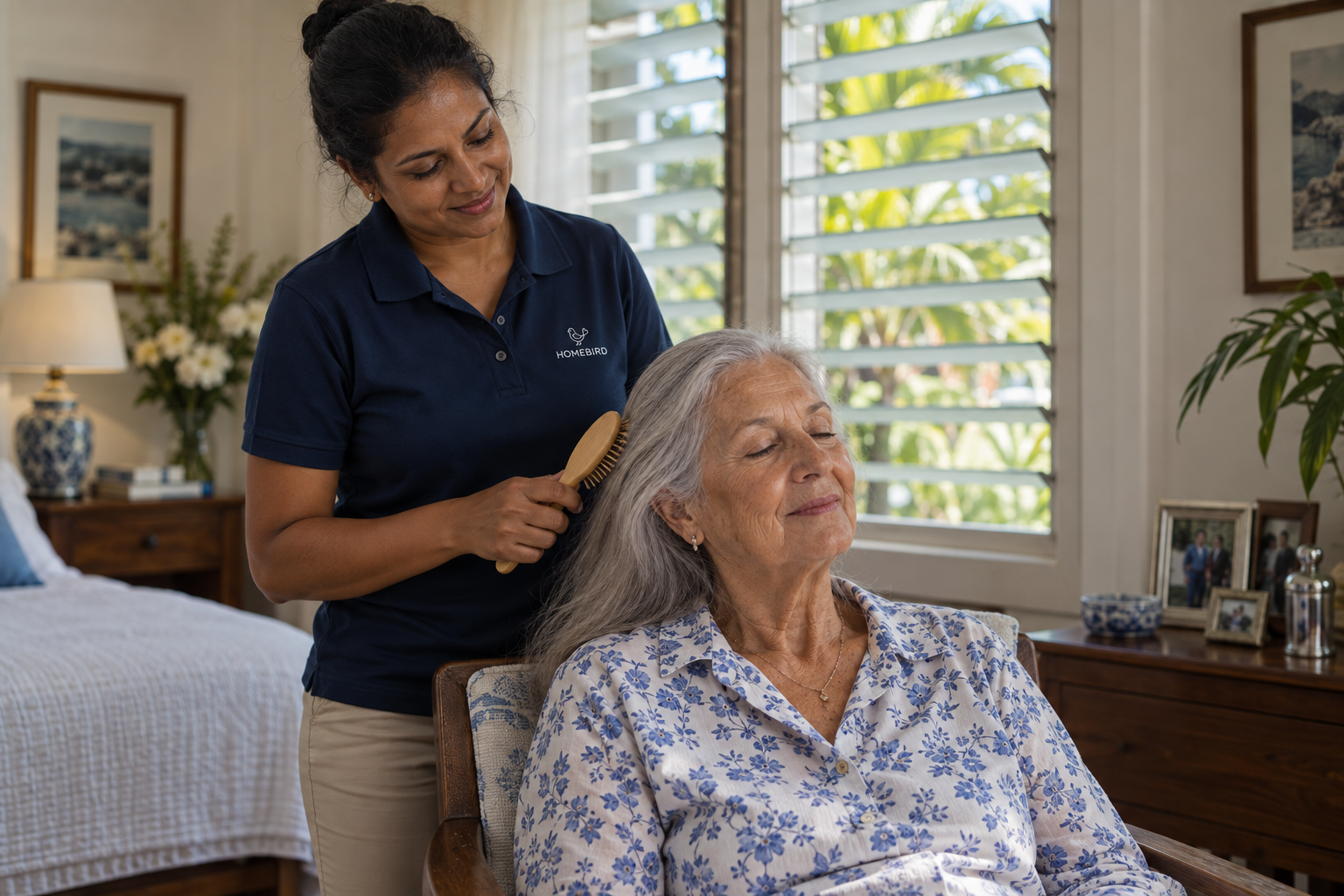
They have now done this three times a week for seven months.
Personal care for the elderly at home is the part families dread most, and it is the point at which many decide the situation has become unmanageable. It is worth knowing that the difficulty is usually not the washing. It is who is doing it.
What personal care covers
Washing, whether that is a shower, a bath or a wash sitting down. Dressing and undressing. Hair, shaving, nails, teeth. Help getting on and off the toilet, and managing continence if that has become an issue. Getting in and out of bed and up from a chair. Help with eating where that is needed.
It is not nursing. Wound dressing, injections and catheters are clinical work requiring a qualified nurse, and they are a separate category. What personal care needs instead is somebody trained to do intimate things safely, and without either of you finding it unbearable, which is a real skill and not the same skill.
It is also usually less time than families imagine. Help with a morning wash and getting dressed is often under an hour, and for many people that one hour is the only assistance they need all day.
Why a carer is often easier than family
Most families assume that if help is needed, family should give it, and that bringing in someone else is a small failure. In practice it is frequently the other way round, for three reasons that have nothing to do with competence.
There is no history in the room. A carer has never been told off by this woman, never been a teenager in her house, never seen her as anything other than an adult who needs a hand with something. Between a parent and a child there is fifty years of a particular relationship, and being undressed in front of your own daughter overturns it in a way that being undressed in front of a professional does not.
Neither of you has to pretend. A carer does this every day and finds it unremarkable, which is enormously freeing for the person being helped. Your mother can see that you are steeling yourself. She cannot unsee it, and it is often the thing that makes her refuse.
It protects the relationship you actually have. A daughter who spends three mornings a week doing something both of them dread is spending her limited time with her mother on the worst possible task. Handing that over does not mean seeing less of her. It usually means the visits become about something other than the bathroom.
None of this means families should not do it. Many do, for years, and do it well. But if you are doing it because you assumed there was no acceptable alternative, that assumption is worth re-examining.
A carer has no history in the room. Between a mother and a daughter there is fifty years of it.
What good personal care actually looks like
The technical part is the straightforward part. What separates good personal care from adequate personal care is almost entirely about how it is done.
Asking before doing, every time. Not once at the start, but as it goes: shall I do this now, is the water right, are you ready. Being handled without warning is what makes people feel like objects.
Only what cannot be done alone. If she can wash her own face and arms, she washes her own face and arms. A carer who does everything because it is quicker is taking something away that was not offered.
Covered, and warm. Nobody should be left uncovered or cold for longer than the task requires, and a good carer manages this without making a performance of it.
Unhurried. Rushing is what turns assistance into being processed. It is also when accidents happen.
The same person. Continuity matters everywhere in home care and it matters most here. Being washed by somebody you know is a different experience from being washed by whoever was available, and this is worth insisting on.
Ordinary conversation. The single most effective thing a carer does in a bathroom is talk about something else entirely.

A man or a woman
Ask, and take the answer seriously.
Most people have a clear preference for personal care and most will not raise it unprompted, either because they think it will cause difficulty or because they are embarrassed to be asked. In Mauritius, across Hindu, Muslim, Christian and Creole households alike, modesty around this is generally strong, and a mismatch is one of the most common reasons an arrangement quietly stops working.
It is a reasonable request, not a difficult one, and any provider should ask before you have to.
Toileting, which nobody wants to discuss
This is the hardest part for everyone and it is worth saying a few things about it plainly.
It is common. Needing help getting on and off the toilet, or managing continence, is an ordinary part of getting older for a great many people, and there is nothing shameful in it however it feels.
It is often what tips a family from managing to not managing. A daughter who has coped with washing for a year will frequently reach her limit here, and that is not a failure of love.
And it is the clearest case for a trained carer, because it is where dignity is most at risk and where the difference between someone who does this professionally and someone who is improvising is most obvious to the person on the receiving end.
If continence has changed recently, that is also worth mentioning to a doctor rather than simply managing around it, since it sometimes has a treatable cause.
Reaching your limit with this is not a failure of love. It is the most common reason families ask for help, and the least talked about.
It is not the end of independence
For many older people, accepting help with washing feels like the line. Once that goes, everything goes, and somewhere behind it sits the fear that the next conversation is about leaving the house.
It is worth saying the opposite plainly, because it is usually true. Help with washing is often what allows somebody to stay at home rather than what precedes them leaving it. It is also, quite often, what gives them back the rest of the day, because ninety minutes of struggling with the shower takes the morning and most of the energy in it.
We have written more about that in needing help does not mean losing independence, which is the argument underneath this whole chapter.
Starting
Two things make the beginning easier.
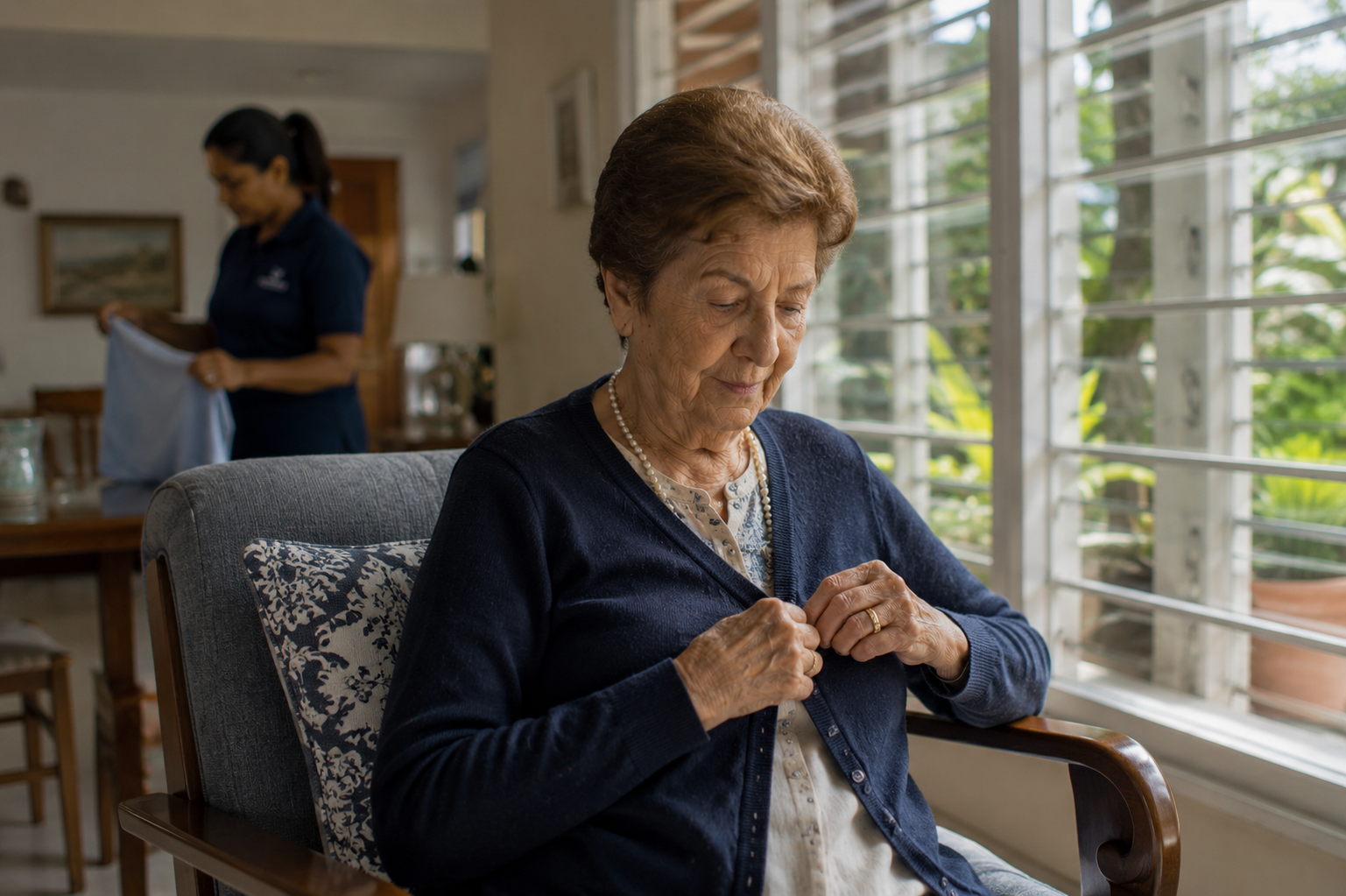
Start with something less exposing. A carer who has been coming for a fortnight to help with meals and the house is a known person by the time washing comes up, and that is a completely different proposition from a stranger arriving to undress your mother on day one.
And let her decide the details she can decide: which days, what time, whether the door stays open, what she manages herself. The washing may not be negotiable. Almost everything around it is, and that is where the dignity lives.
If you are working out what level of help is needed overall, how much care your parent actually needs covers the whole range. If it is mainly company and practical help rather than personal care, companion care is the lighter option.
This article is part of The Mauritius Guide to Caring for an Elderly Parent at Home, our free guide for families across the island. See the full guide.
Talk to Homebird
Homebird is a professional in-home care agency serving families across Northern Mauritius. If you have reached the point where washing or dressing has become difficult for everybody involved, that is an ordinary reason to call and we are glad to talk it through. No obligation, no pressure.
WhatsApp or call: +230 5811 8335
Email: hello@homebird.mu
Care that feels like family.
This article is for general information and is not a substitute for professional medical advice. If your parent's mobility or continence has changed recently, speak to their doctor.