
Falls and Mobility: Preventing Them, and What to Do in the Ten Minutes After One
She caught her foot on the step down to the garden, put a hand out, grazed her knee and was perfectly fine. You only heard about it three days later, in passing, because you noticed the plaster.
That fall did not matter. The next one might, and the reason the first one is worth paying attention to is that it is the best warning anybody is going to give you.
Preventing falls in an elderly parent is not mainly about the house, which is the part everybody starts with. Between 28 and 35 per cent of people over sixty-five fall in any given year, rising to between 32 and 42 per cent of those over seventy. Most of those falls do no harm at all. Between a fifth and a third cause a real injury, and the small number that break a hip change everything that comes after.
This covers both halves. What actually reduces the risk, and what to do in the ten minutes after a fall, which is where well-meaning families most often make things worse.
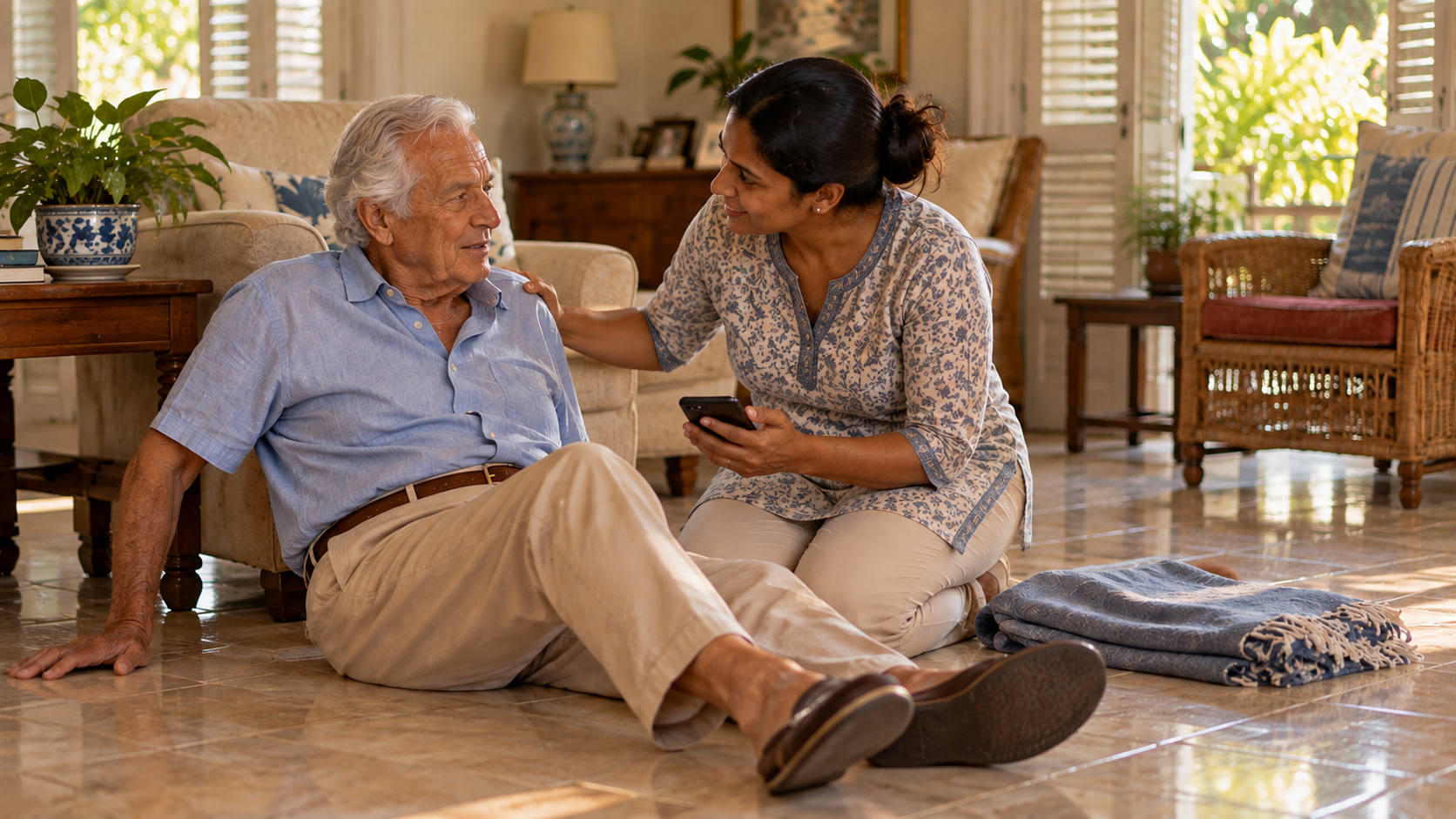
The first fall is information
A fall is almost never random. It is usually the visible end of something that has been building quietly for months. Strength going. A tablet that was added in March. Blood pressure that drops when she stands up. Eyesight that has changed since the last pair of glasses. A floor that was always slippery and a person who used to be able to cope with it.
Which means the useful question after a minor fall is not whether she is hurt. It is why it happened, asked properly, that same week, while she can still remember what she was doing and which way she was going.
There is a second thing a fall does, and nobody warns families about it. It frightens people, and frightened people move less. Moving less loses strength and balance, and losing strength and balance makes the next fall more likely. A fall that caused no injury whatsoever can start that cycle inside a fortnight, and once it is running it does more damage over a year than the fall did in a second.
So half the job after a fall is keeping somebody moving while they are frightened. That is harder than it sounds and more important than anything you can buy.
The first fall is the best warning you will get. The useful question is not whether she is hurt. It is why it happened.
Most of the risk is in the person, not the house
The house is worth sorting out, it is the easiest part of the problem, and it takes an afternoon. We have a room-by-room checklist for exactly that, and it is the right place to start because it is the part you can finish.
But the larger share of the risk walks around inside the person, and almost none of it is visible from across a room.
Strength and balance. The quiet one. Both decline gradually from the sixties onwards, faster after any illness or spell in bed, and nobody notices until standing up from a low armchair becomes a manoeuvre. This is the biggest single factor and also the most fixable, which is why it has a section of its own below.
Medication. Anything that causes drowsiness or affects blood pressure raises the risk, and sleeping tablets are the clearest example of all. The number of medicines matters as much as which ones. Somebody on four or more regular tablets sits in a higher-risk group by arithmetic alone, because the interactions multiply. Never stop or change anything yourself. Ask the doctor or pharmacist for a review of the entire list, with falls given as the reason for asking.
Blood pressure when standing up. If she goes light-headed, has to pause, or reaches for the furniture when she stands, say exactly that to her doctor. A drop in blood pressure on standing is common in older people, it is measurable in a two-minute test lying down and then standing, and it is frequently caused by medication that can be adjusted. It is one of the few causes of falls with a genuinely simple fix, and it is almost never found unless somebody raises it.
Eyes. Glasses more than two years old, untreated cataracts, and varifocals on stairs, which blur precisely the part of the visual field needed to judge the edge of a step. A separate single-vision pair for walking around is a real and underused solution, and an optician will make one up in a week.
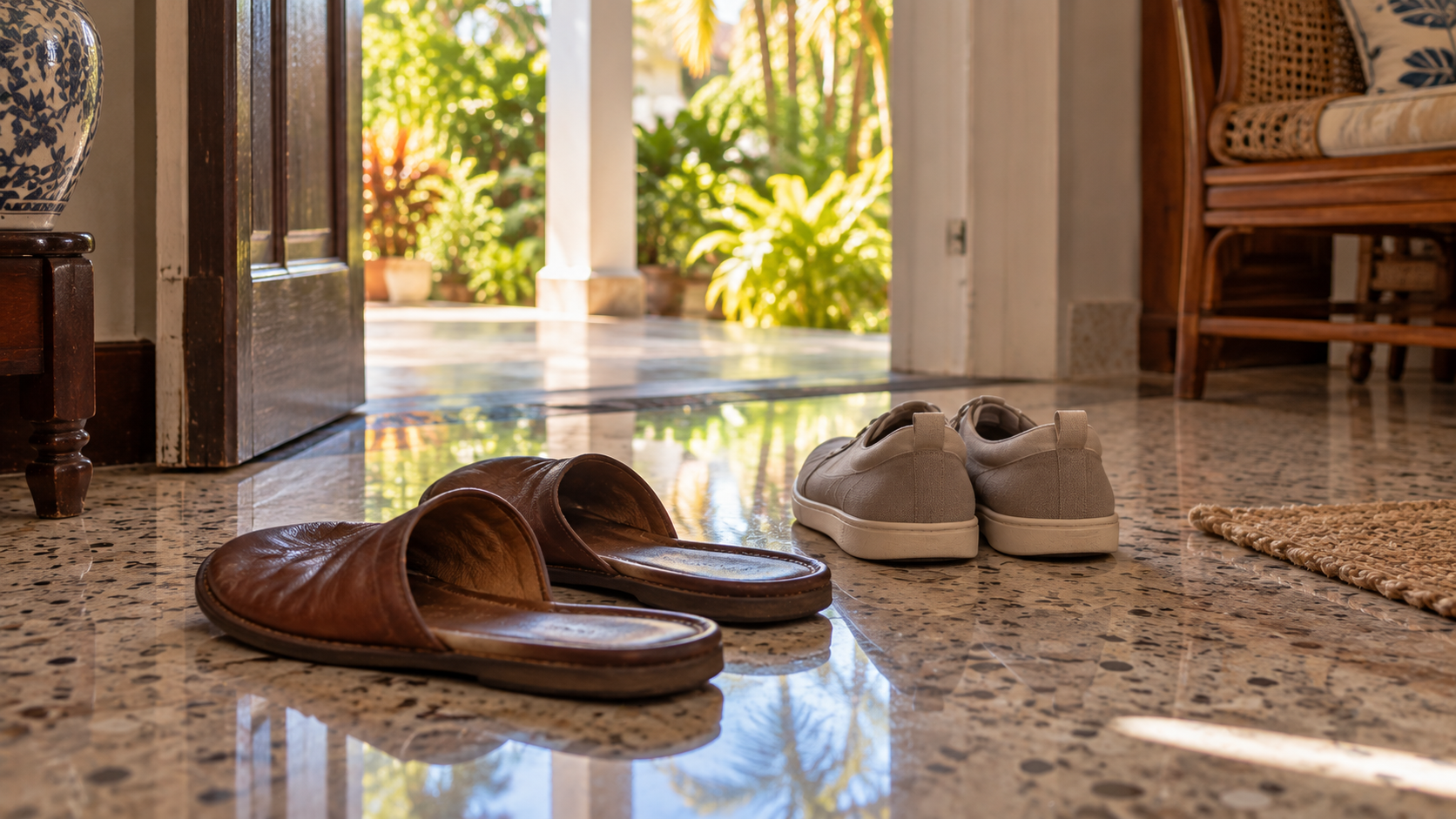
Feet, and what is on them. Long toenails, numbness and pain all change the way somebody walks, and all are easy to miss on a person who dresses themselves. Then there is what they have on their feet indoors, which in a Mauritian house deserves saying plainly, because it is almost always the wrong thing. Backless slippers and mules come off at the heel on a step. Smooth leather soles on polished tile or terrazzo have no grip at all. Socks on a hard floor are worse than bare feet. The answer is unglamorous and it works: a closed shoe with a back, a flat sole and a bit of grip, worn in the house, not only for going out. It is the cheapest and least popular piece of fall prevention there is.
The trip to the bathroom at night. A large share of falls at home happen between the bed and the bathroom, in the dark, half asleep, often in a hurry. In a bigger house that walk is longer and usually involves a level change. A light on the route that comes on by itself, a clear floor and a torch within reach of the bed address the single most predictable fall in the building.
Wine with dinner. Worth a quiet look, without a lecture. Two glasses that were nothing at sixty interact differently with eighty-year-old balance and a handful of tablets.
The one thing that works better than everything else
If you do one thing from this entire page, do this one.
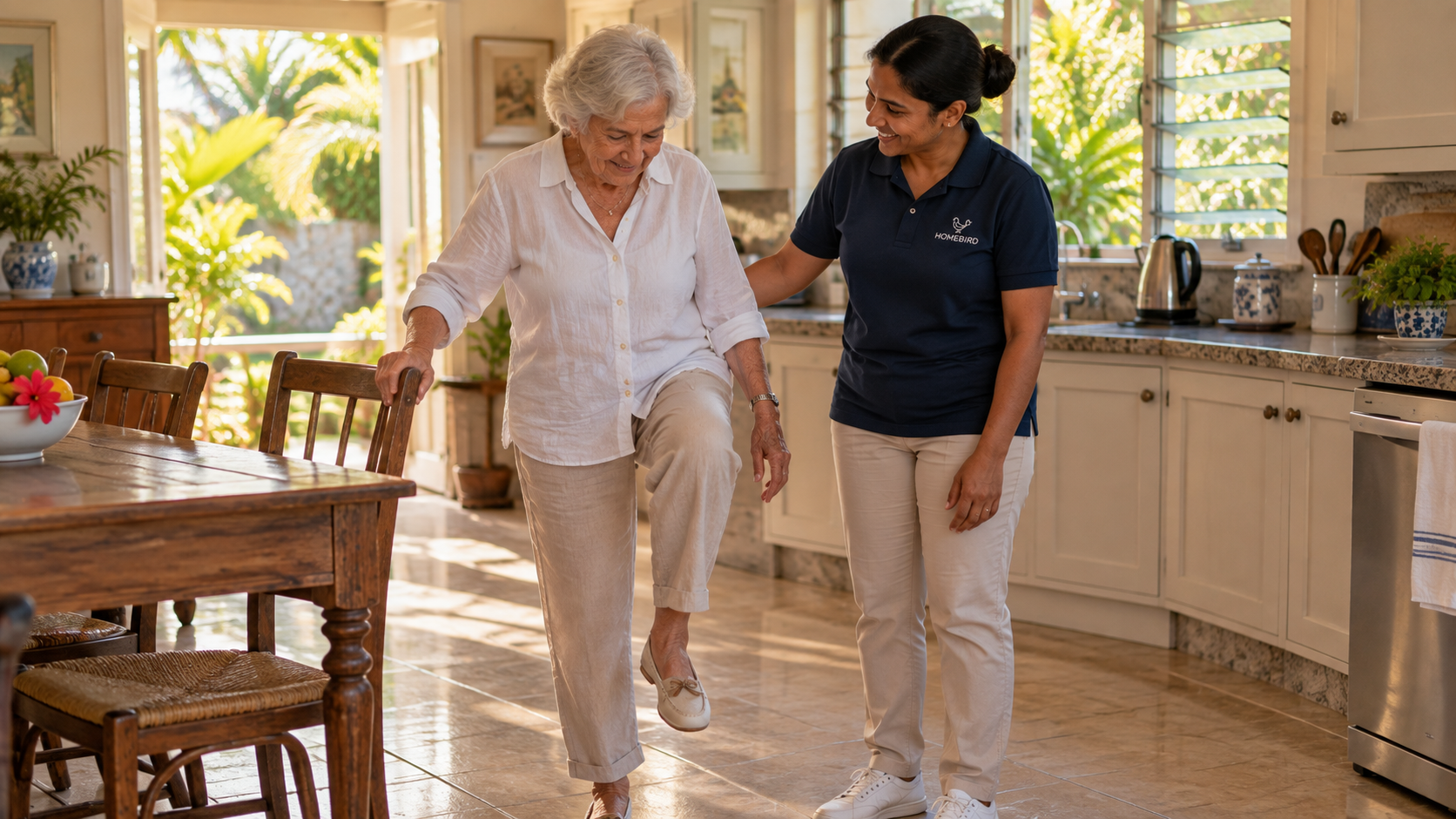
Exercise that trains balance is the most effective fall prevention there is, and the evidence behind it is unusually strong. A large review of the research used to inform the World Health Organization's physical activity guidelines found that balance and functional exercises reduced the rate of falls by around 24 per cent, that combining them with strength work took it to around 28 per cent, and that Tai Chi achieved around 23 per cent. Programmes including three hours a week or more of this kind of exercise reduced falls by around 42 per cent.
Just as useful is what did not clearly work. Walking on its own. Resistance training on its own. Dancing. All are good for other reasons and none of them reliably reduced falls. That matters, because walking is what most families encourage in good faith, and it is not the thing that trains balance.
What it looks like at home, holding onto something at first:
Standing on one leg at the kitchen counter while the kettle boils, a few times on each side
Standing up and sitting down from a dining chair, repeatedly, without using the arms
Heel raises at the sink
Walking heel to toe along a passage with a hand near the wall
Sideways steps along the edge of a counter
It is dull, it looks like nothing, and it is more effective than every piece of equipment mentioned on this page put together. Two honest caveats: it takes around twelve weeks before it counts for anything, and it only keeps working while it is still being done. It is a habit, not a course.
And one recommendation almost nobody takes up. A single private physiotherapy assessment, here in Mauritius, is among the best-value things available in this whole subject. A physiotherapist watches somebody walk, stand up, turn and reach, finds the specific weakness, and writes four or five exercises for that person rather than the five generic ones above. It is one appointment, it is not expensive, and it turns a general list into a plan. If there is any heart or joint problem, recent surgery or a fracture, it stops being a good idea and becomes the necessary first step before any exercise at all.
Three things that are particular to a Mauritian household
The floors. Polished tile, terrazzo and smooth stone are what almost every house here is built on, they are beautiful, and they are unforgiving. They are hardest the moment they have been washed, and nobody tells the person who has just washed them that somebody is about to walk across. The same applies to a wet verandah after rain and to the surround of a pool. Two things help more than any product: agreeing that floors get washed when the person is sitting down and not mid-morning when everybody is moving about, and keeping one route through the house, from bedroom to bathroom to kitchen, free of anything slippery at all times.
The helper goes home at four. This is the gap nobody plans for. In a house with daily help, somebody is usually around from morning until mid-afternoon, which is genuinely protective and which quietly reassures the whole family. But falls do not keep office hours, and a large share of them happen in the evening, at night on the way to the bathroom, or at the weekend. Families look at the weekday arrangement, conclude that their mother is not alone, and never examine the sixteen hours when she is. Count the hours honestly. The answer is frequently more exposed than anybody has noticed.
The instinct to drive. If there has been a bad fall, the reflex here is to get him into the car and go, because waiting feels like doing nothing and the clinic is twenty minutes away. With a suspected hip, back or neck injury that is the wrong call, and the reason is specific: getting somebody in and out of a car seat is exactly the movement that turns a crack into a break. It is worth finding out now, while nothing has happened, what the arrangement is for an ambulance to the clinic your family actually uses, and writing the number down beside the phone. That is a ten-minute job on a quiet afternoon and it is unanswerable at eleven at night.
What to do in the first ten minutes after a fall
This is the part worth reading before you ever need it, because in the moment nobody reads anything.
Do not rush to lift them. Every instinct says get him off the floor and into a chair, and it is the one thing most likely to cause harm. Lifting somebody with a broken hip, or hauling them up by an arm, turns an injury into a worse injury. The floor is uncomfortable. It is not dangerous for the next few minutes.
Then, in order:
1. Get down to their level and stay calm. Your face is the first information they get about how bad this is.
2. Ask before you touch anything. What happened. Did you hit your head. Did you black out, even for a second. Where does it hurt. Can you move your arms and legs.
3. Look before you move them. One leg appearing shorter than the other or turned outwards. Any obvious deformity. Severe pain in the hip, groin, back or neck. An inability to move a limb. Bleeding. Slurred speech, a drooping face, or confusion that was not there before.
4. If any of those are present, do not move them at all. Cover them with a blanket, put a cushion under the head if it can be done without moving the neck, stay with them, and get help. Moving them is not your job at that point.
5. If none are present and they want to get up, let them do it themselves, in stages, in their own time. Roll onto the side. Push up onto hands and knees. Crawl to a solid chair. Use the chair to come up. Your job is to hold the chair still and talk them through it. You do not take their weight. If it cannot be done without you lifting, stop and call somebody who can help properly.
6. Then sit with them for twenty minutes before deciding anything. Pain and stiffness often arrive late, and somebody who feels fine on the floor can be unable to stand half an hour later. Nobody should be left alone immediately after a fall.
Call an ambulance, SAMU on 114, if they lost consciousness at any point, they cannot be roused properly, you suspect a broken hip or any broken bone, the pain is severe, there is weakness or numbness, there is chest pain or difficulty breathing, there is bleeding you cannot stop, or you simply cannot get them up safely.
A head injury needs its own line. Anybody taking a blood thinner who hits their head should be seen the same day, even if they feel completely well and there is nothing to see, because bleeding inside the head can develop slowly over hours. For anybody who has hit their head, watch over the next day or two for drowsiness, a headache that gets worse rather than better, repeated vomiting, or new confusion, and treat any of those as a reason to go in.
If somebody has fallen
The first ten minutes
Do not lift them. Work through it in this order.
Get down to their level
Stay calm. Your face tells them how bad this is.
Ask before you touch
What happened? Did you hit your head? Where does it hurt?
Look before you move them
A leg turned out, deformity, severe pain, weakness, slurred speech.
If anything is wrong, do not move them
Blanket, stay with them, get help.
If not, let them get up themselves
Onto the side, onto the knees, up using a chair. You hold the chair.
Sit with them for twenty minutes
Pain often arrives late. Nobody is left alone after a fall.
Call an ambulance, SAMU 114, if
They lost consciousness, or cannot be roused.
You suspect a broken bone or a broken hip.
Severe pain, weakness, numbness or breathlessness.
You cannot get them up safely.
The hours on the floor do more damage than the fall
The fall itself takes a second. Somebody who falls alone and cannot get up can be on the floor for hours, and that is frequently the part that causes lasting harm. Dehydration. Pressure damage to the skin. Getting genuinely cold, which happens here too on a tiled floor at three in the morning. Muscle damage that affects the kidneys. And the fear afterwards, which is in a different league from the fear after a fall somebody got themselves up from.
So the honest question is not whether she might fall. It is how long she would be lying there before anybody knew. Ask it about a Saturday night, not a Tuesday morning, because Tuesday morning is the hour that is already covered.
A mobile phone is not the answer families assume it is, because a phone on the kitchen counter is not where a person on the floor is. Worth thinking through properly:
A phone carried in a pocket all day, every day, which is a habit rather than a purchase
A call at the same time every evening, which narrows the worst case to one night
Somebody coming in at the start and the end of the day rather than only the middle
A neighbour with a key and your number, which narrows it to minutes and costs nothing
A pendant alarm, if she will genuinely wear it, which is a bigger if than any salesman admits and has more to do with how medical it looks than how much it costs
It is an uncomfortable conversation and it is worth more than any grab rail in the house. It is also far easier to have calmly, in advance, than in a hospital corridor afterwards.
The question is not whether she might fall. It is how long she would be on the floor before anybody knew. Ask it about a Saturday night, not a Tuesday morning.
What to do in the days afterwards
Write the fall down the same day. The date and time, where it happened, what she was doing, whether she hit her head, whether she lost consciousness, how long she was on the floor, what hurt afterwards, and what she thinks caused it. Memory rearranges all of this within a week, and the pattern across three falls is what a doctor needs rather than the detail of any one of them.
Then take it to the doctor and ask for two specific things, because neither is usually offered unprompted: a review of every medicine she takes, with falls given as the reason, and a blood pressure check taken lying down and then standing up. That half hour is the highest-yield thing available in this entire subject and it almost always has to be requested.
Three falls in a year, or a single fall with no explanation at all, is a reason to push for a proper assessment rather than accept reassurance. An unexplained fall in an older person is a symptom, not an accident.
How to raise it without being managed
Nobody has ever responded well to being told they are a falls risk. The phrase turns a person into a problem, and the usual reply is that it was just the step and it will not happen again.
What works better is to frame every suggestion around continuing to do things rather than stopping. The shoes are so she can keep walking down to the garden. The exercises are so she can keep getting out of her own chair. The physiotherapist is so somebody competent can tell her she is fine, which is frequently what she wants to hear and occasionally true.
It also helps to understand what the fear is actually about. Very few people are frightened of falling. They are frightened of what a fall would lead to: the hospital, losing the house, being discussed rather than consulted. If you can say plainly that the whole point of this is to avoid that outcome rather than hasten it, it becomes a completely different conversation.
Where to start this week
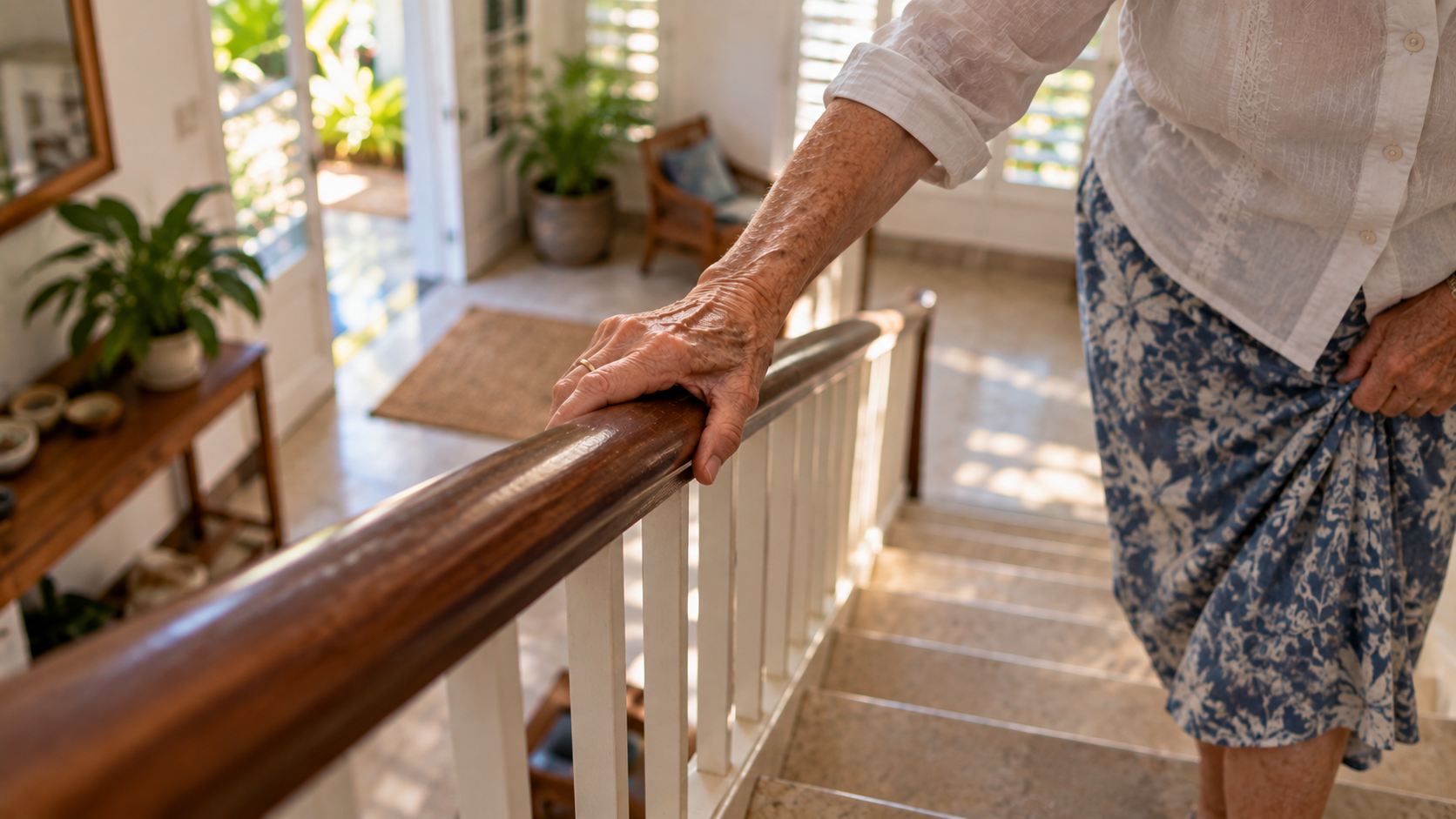
Walk the house with the checklist on a Saturday afternoon and finish it. Book one physiotherapy assessment. Buy a proper closed shoe for indoors and accept that it will be resisted. Ask for the medication review and the standing blood pressure check at the next appointment, in those words. Get her standing on one leg at the kitchen counter while the kettle boils, starting today, and keep it going for three months before expecting anything of it.
Then count the hours in the week when nobody is in the house, and decide calmly what would happen if she were on the floor at ten o'clock on a Saturday night. That decision is far easier to make while it is still hypothetical.
This article is part of The Mauritius Guide to Caring for an Elderly Parent at Home, our free guide for families across the island. See the full guide.
Talk to Homebird
Homebird is a professional in-home care agency serving families across Northern Mauritius. If somebody has had a fall, or if the worry is the evenings and weekends when nobody is in the house, that is a reasonable thing to call about. No obligation, no pressure.
WhatsApp or call: +230 5811 8335
Email: hello@homebird.mu
Care that feels like family.
This article is for general information and is not a substitute for professional medical advice. If somebody has fallen and you are unsure how badly they are hurt, do not move them, and seek medical help. In an emergency in Mauritius, call SAMU on 114. Always speak to a doctor or pharmacist before changing any medication, and to a doctor or physiotherapist before starting new exercise after an illness, surgery or fracture. Figures are from the WHO Global Report on Falls Prevention in Older Age and a systematic review published in the International Journal of Behavioral Nutrition and Physical Activity.