
How to Share the Care of an Elderly Parent With Your Siblings
Somebody in your family collected a prescription from the pharmacy in Goodlands twenty-six times last year.
They also took your mother to four appointments, sat with her the weekend she had the chest infection, noticed she had stopped eating properly in March, arranged the man to fix the gate, and answered the phone at half past ten on a Tuesday night because she could not find her glasses and was frightened.
Nobody decided this. There was never a conversation where the family agreed that one person would do all of it. It simply happened, the way these things do, and the reason sharing the care of an elderly parent is so difficult is that most of the work is invisible to everybody except the person doing it.
How it ends up with one person
It is almost never a decision. It is a series of small defaults that hardened over about two years.
Someone lived nearest, so they went round when the water was off. Someone was between jobs when your father was in hospital, so they did the visiting. Someone is calmer on the phone with doctors, so they became the one who rings. Someone is the eldest daughter, and in a great many Mauritian families that alone is enough.
None of those is unfair on its own. What makes it unfair is that they accumulate, and that the person carrying them rarely says so, because saying so feels like complaining about your own mother.
The person doing most of it did not volunteer. They were simply the one who was there the first few times.
Start by writing it down, not by dividing it up
The instinct is to go straight to a fair split. Do not. The first job is simply to make the whole list visible, because until everyone can see it there is nothing honest to divide.
Write down everything that is currently being done for your parent, and put a real name beside each one. Not "we all help", not "whoever is around". A name. Twenty or so lines will cover most families, and it takes about fifteen minutes.
What usually happens next is quiet. A brother who genuinely believed he was doing his share sees his name twice on a list of twenty. That is not a bad moment. It is the most useful thing that has happened in that family for a year, and it works far better than any argument, because nobody had to accuse anybody of anything. The list did it.
The work that never makes the list
Shopping, cooking and lifts to the doctor get counted, because they take visible time. Four things almost never do, and between them they are usually the heaviest part of the load.
Noticing. Registering that she is quieter this month, that the fridge is emptier than it should be, that two tablets are still in Wednesday's compartment. This is the most valuable job in the whole list and it looks like nothing.
Remembering. Holding the appointment dates, the prescription cycle, which specialist said what. Somebody is carrying all of that in their head at all times.
Being on call. Not the phone calls themselves, but the low background knowledge that you are the one who will be rung, which never quite switches off.
Telling everyone else. Updating three siblings after every appointment is itself a job, and it is invariably done by the person who was already at the appointment.
The work that never makes the list
Four things nobody counts
They take no visible time, and they are the heaviest part of the load
What a sibling overseas can actually take on
In a lot of Mauritian families at least one sibling is in the UK, France, Australia, Canada or South Africa, and the usual assumption is that they cannot help much. That is only half right.
They cannot be in the house. They cannot notice, and they cannot be there by four o'clock. Those two things are genuinely bound to geography and it is not worth pretending otherwise.
Almost everything else travels. Booking appointments, chasing referrals, dealing with the bank, managing bills and paperwork, keeping the medication list current, researching options, being the one who phones every evening at seven so somebody at home does not have to. Handing the entire administrative load to whoever lives abroad is a genuine redistribution, and it frees the person on the island to do the part only they can do.
It also helps to name the money question rather than leave it hanging. A sibling who cannot be present but earns more elsewhere paying for a carer two mornings a week is not buying their way out. It is the same contribution in a different currency, and the family that says so out loud avoids a resentment that otherwise sits there for years.
Someone four thousand miles away can do the bookings, the bills and the chasing. What they cannot do is the Tuesday afternoon.
Having the conversation without it becoming a fight
Four things make this go better.
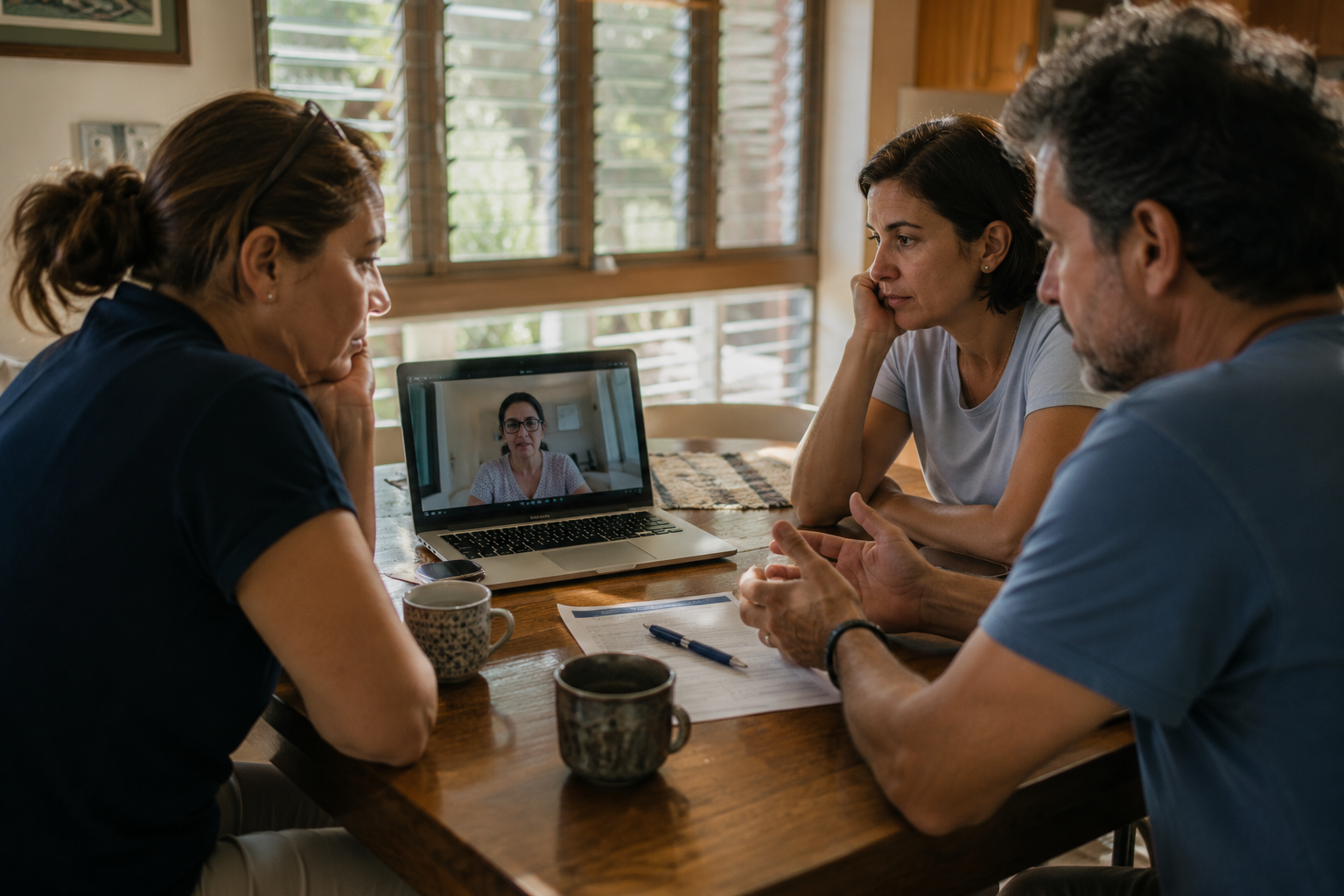
Everyone at once. One call with all of you on it, not a series of separate conversations. Separate conversations are how versions of events develop.
The list first, the feelings second. Start by filling in who does what. It is factual, it is not about anybody's character, and it makes the imbalance a shared observation rather than an accusation.
Ask for specific things. "You need to do more" cannot be acted on and invites a defence. "Could you take over the prescriptions and the appointment bookings" can be said yes to.
Accept partial. A sibling who takes three of the twenty rows has changed the situation. Holding out for exactly equal usually gets you nothing at all.
Then agree when you will look at it again
Every arrangement drifts back. Somebody's job gets busier, somebody has a baby, your mother needs more than she did, and within four months the list quietly looks the way it did before.
So set a date now to go through it again, every three months or after anything significant: a fall, a hospital stay, a new diagnosis. Reviewing something you all agreed is a much easier conversation than raising it from nothing a second time.
If it becomes clear that the total is more than the family can carry however you divide it, that is worth knowing plainly rather than slowly. It is a common point to bring in some paid help, and the reasons behind it are not personal: families are smaller than they were and more spread out, which we have written about in why elderly care in Mauritius is changing.
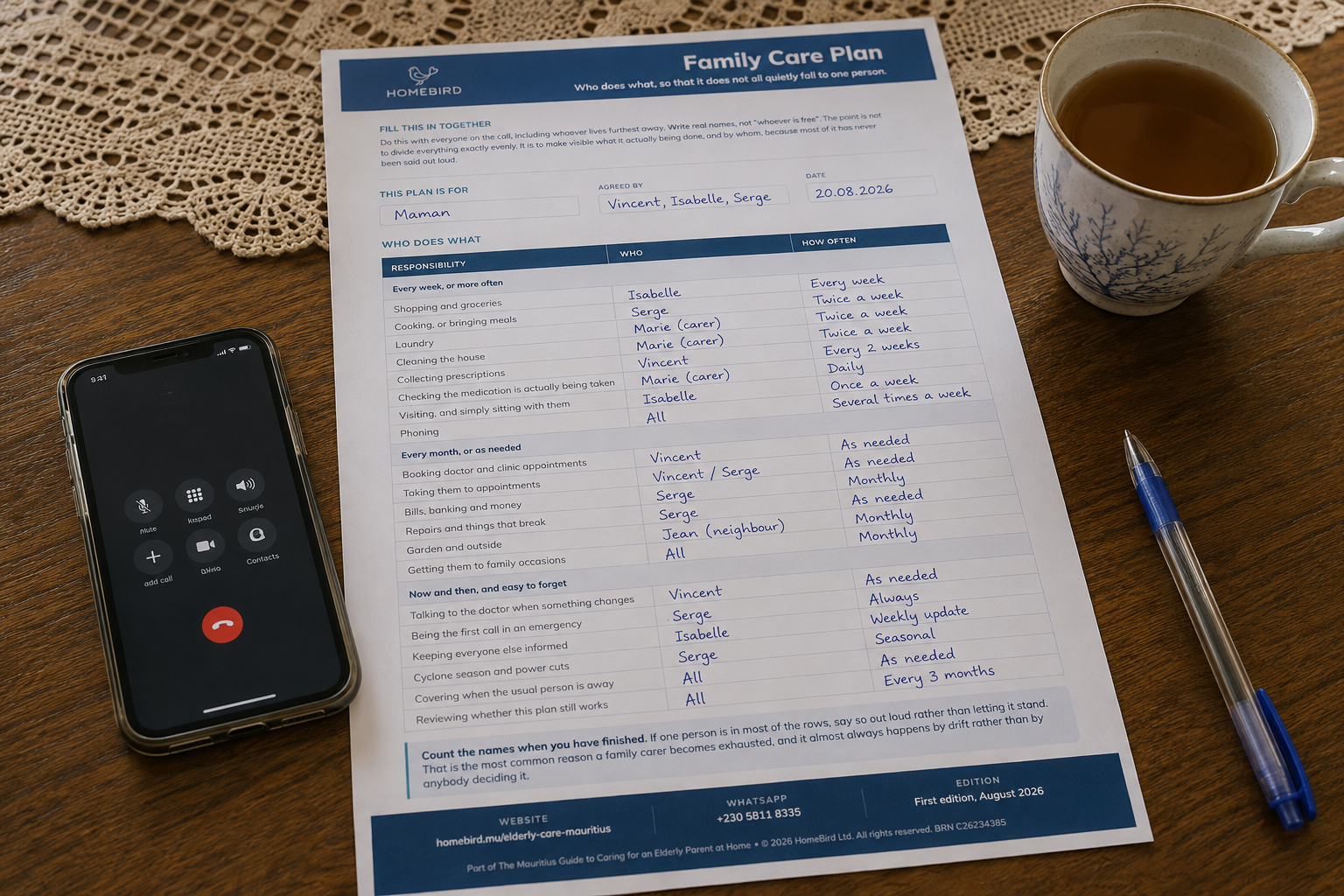
Download the family care plan
One page, twenty responsibilities already listed, with space for a name and how often beside each. Print it before the call and fill it in together. There is nothing to sign up for.
It forms part of The Mauritius Guide to Caring for an Elderly Parent at Home, our free guide for families across the island. If you are sharing the day to day between several people, the daily care log is worth printing as well, so that whoever comes tomorrow is not starting from nothing.
This article is part of The Mauritius Guide to Caring for an Elderly Parent at Home, our free guide for families across the island. See the full guide.
Talk to Homebird
Homebird is a professional in-home care agency serving families across Northern Mauritius. If your family has reached the point where the list is longer than the people on it, we are glad to talk through what support might look like. No obligation, no pressure.
WhatsApp or call: +230 5811 8335
Email: hello@homebird.mu
Care that feels like family.
This article is for general information and is not a substitute for professional advice.