
What Actually Happens During a Home Care Assessment
The word assessment does us no favours. It sounds like a clipboard, a stranger in the house, and a judgement being made about whether your mother can still cope. Several families have told us they put off calling for weeks because of that word alone.
So here is what a home care assessment in Mauritius actually involves, from the first message to the first morning a carer arrives. No mystery, and nothing you have to prepare for.
It starts with a message, not a form
Most families reach us on WhatsApp, and usually with something fairly vague. My father is managing but I am not sure how long that will last. My mother had a fall last month and I live in France. We are not coping and I do not really know what I am asking for.
That is a perfectly good place to start. You do not need to know what level of care you want, or how many hours, or what any of it is called. Working that out is our job, not yours.
What follows is a phone conversation, usually the same day. Fifteen or twenty minutes, no charge, and no visit yet. We are trying to understand three things: what has changed recently, what a normal day looks like now, and what is worrying you most. Often the last one is the most useful answer, and it is rarely the same as the first.
You do not need to know what level of care you want, or how many hours, or what any of it is called. Working that out is our job, not yours.
The process
What happens, step by step
From your first message through to care beginning at home
Message us
A phone conversation
The home visit
Your written care plan
Meeting your carer
Care begins, and is reviewed
The home care assessment itself
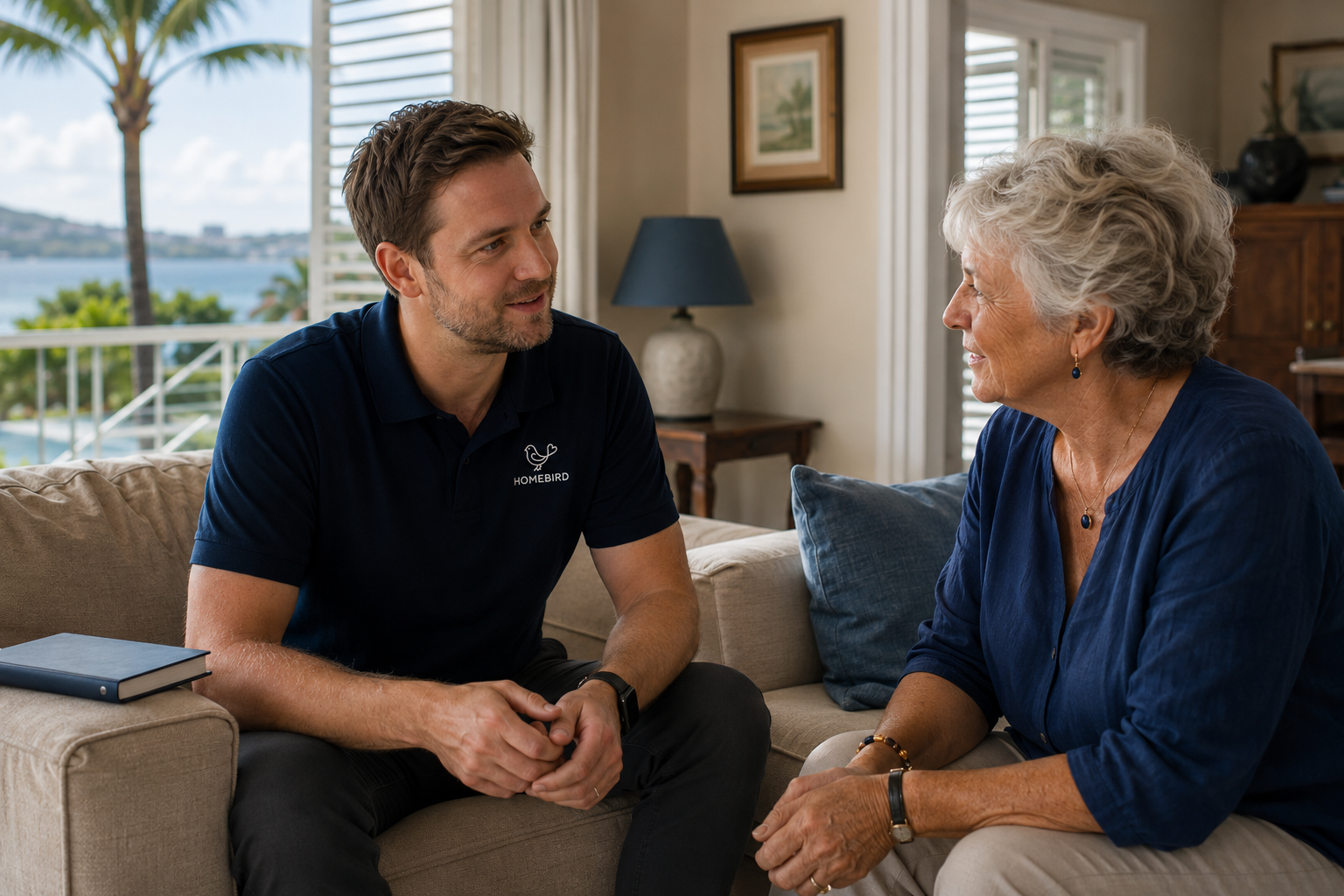
If it seems we can help, our Care Operations Director, visits the home. He is a qualified Health Care Assistant, and he does every assessment himself rather than sending someone else. That visit is free, and agreeing to it commits you to nothing at all.
It takes about 30 minutes. Most of it is conversation, and most of that conversation is with your parent rather than about them, which matters more than it sounds. Someone who has been discussed over their own head for six months tends to notice when a stranger asks them directly what they would like.
What he is actually doing while you talk:
Understanding the day. When they wake, what they eat, when they are strongest, when they tire, what they still do themselves and would like to keep doing.
Looking at mobility. How they get out of a chair, how they manage the step at the door, whether they steady themselves on furniture without noticing they are doing it.
Going through medication. What is prescribed, who prescribes it, which pharmacy, and whether the system for remembering it is actually working.
Walking the house. The bathroom, the bedroom, the route between them at night. The same walk described in our home safety checklist.
Asking about the people. Which doctor, which pharmacy, who the neighbours are, who to call in an emergency, and which mandir, church, kovil or mosque they attend if that matters to them. We record their own priest, pandit, imam or pastor by name, because at some point that will be the person the family wants.
Listening for what is not said. Loneliness, low mood and quiet confusion do not appear on any form, and they are frequently the real reason a family called.
What you do not need to do
You do not need to tidy the house. A house that has been tidied for a visitor tells us less than one that has not, and we are not there to judge the housekeeping.
You do not need a diagnosis, a doctor's letter, or any paperwork. If there are medical records to hand they help, but nothing waits on them.
And you do not need to have persuaded your parent yet. It is common for the person receiving care to be somewhere between unconvinced and openly against the idea. That is a normal starting point rather than a problem, and a conversation with someone outside the family often lands differently. We have written separately about how to open that conversation.
What comes back to you afterwards
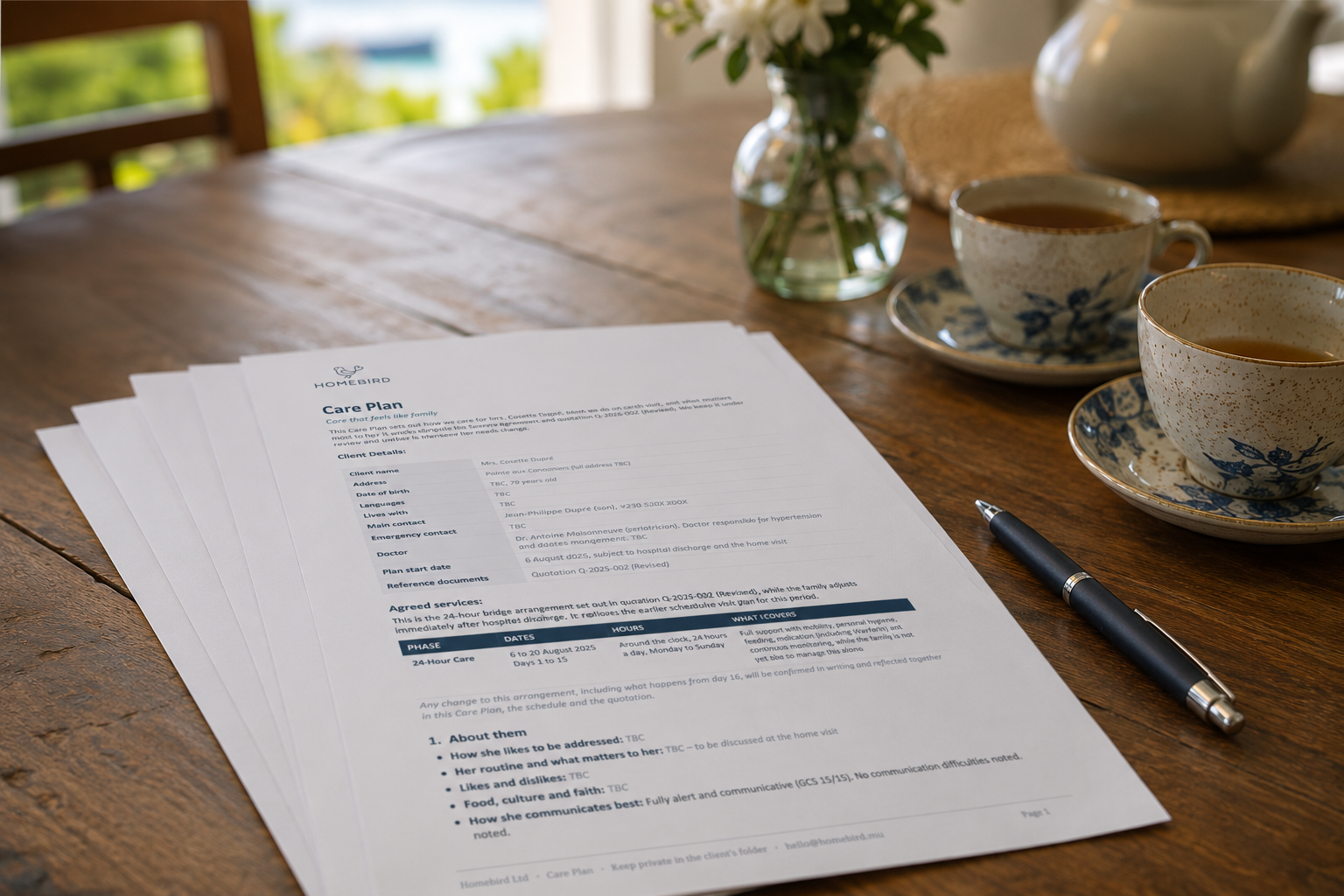
Within two working days you receive a written care plan. Not a quote with a number on it, a plan.
It sets out what support is recommended and why, which grade of carer that calls for, how many hours and at what times, what the carer will do and what they will not, and what it costs. Our rates are published on the website, so the figure in your plan is the figure on the price list. There is no negotiation, and no different number for a different family.
You are free to take it away, discuss it with a sibling overseas, show it to your parent's doctor, or think about it for a fortnight. Nothing starts until you say so, and there is no charge for any of this.
Matching the carer
This is the part families ask about most, and it is the part that decides whether the arrangement works.
We match on the practical requirements first: the grade of care needed, the language spoken at home, whether a man or a woman is preferred for personal care, and availability at the hours you need. Then on the things that are harder to write down. Someone quiet for a quiet household. Someone who will sit and talk for a person who has not had a proper conversation in weeks.
You meet the carer before care begins. If the fit is wrong, tell us and we change it. That is not a difficult conversation and you will not offend anyone. A carer is in your parent's home for hours at a time, and the wrong pairing is nobody's fault but it does need fixing.
And then it keeps changing
An assessment is a photograph of one afternoon, and older people do not stay the same. Someone who needs two mornings a week in March may need daily visits by September, or may steady considerably once they are eating properly and seeing someone regularly. Improvement happens more often than families expect.
So the plan is reviewed regularly, and any time something changes: a fall, a hospital stay, a new medication, a bad few weeks. The carer keeps a daily log, and if something is drifting you hear it from us before you have to ask.
Our rates are published. The figure in your plan is the figure on the price list. No negotiation, and no different number for a different family.
If you are arranging this from overseas
A good number of the families we work with are in the UK, France, Australia, Canada or South Africa, and it is entirely normal for the person paying and the person receiving care to be on different continents.
The assessment happens in the house with your parent, and you join by video call or read the plan afterwards, whichever suits. Written updates matter far more when you cannot drop in on a Sunday, so you get them as a matter of course rather than on request.
Booking one
Send a message. Tell us roughly what is going on, and where in the north your parent lives. We cover Grand Baie, Pereybère, Cap Malheureux, Grand Gaube, Triolet, Goodlands, Petit Raffray and the villages around them.
You are not committing to anything by asking, and the assessment costs nothing whether or not you go ahead.
This article is part of The Mauritius Guide to Caring for an Elderly Parent at Home, our free guide for families across the island. See the full guide.
Talk to Homebird
Homebird is a professional in-home care agency serving families across Northern Mauritius. If you would like to arrange an assessment, or simply talk through what your parent might need, we are glad to help you think it through. No obligation, no pressure.
WhatsApp or call: +230 5811 8335
Email: hello@homebird.mu
Care that feels like family.
This article is for general information and is not a substitute for professional medical advice. A Homebird assessment is a care assessment and does not replace a medical diagnosis or a doctor's opinion.