
Thirty Questions to Ask Before You Hire a Carer in Mauritius
A woman is sitting in your mother's living room in Pereybère. She seems kind. She has been recommended by a neighbour, she is available from Monday, and in about twenty minutes you are going to decide whether to let her into your mother's house for four hours a day.
What do you actually ask her?

Most families have no idea, and there is no reason they should. You do this once or twice in a lifetime, usually under pressure and often from another country. So here are the questions to ask before hiring a caregiver in Mauritius, whether you are interviewing an individual or an agency, along with what a good answer sounds like and what should give you pause.
Why the interview is harder than it looks
Hiring a carer is not like hiring anyone else. You are not really assessing whether someone can do a task. You are trying to work out, in one conversation, whether you would trust this person alone in a house with your mother when she is at her most vulnerable.
That is close to impossible to judge from a conversation, which is why the useful questions are not about warmth. Warmth you will recognise when you see it, and you should trust yourself on it. The questions below are about everything warmth cannot tell you: what happens when this person is ill, who checked that they are who they say they are, what is written down, and whether anyone answers the phone at nine on a Sunday evening.
Ask these of us too. Anyone who will not answer thirty straightforward questions has already given you the answer.
Individual or agency, and why it matters before anything else
Settle this first, because it changes which questions matter most. Neither option is automatically better and plenty of excellent care in Mauritius is delivered both ways.
Hiring an individual directly usually costs less, and the relationship can be closer because there is nobody in between. What you take on is everything the middle would have handled: cover when they are ill, references, insurance, the written agreement, and someone to escalate to when you disagree.
An agency should carry those things for you and charges accordingly. What you should not assume is that it does simply because it calls itself an agency. That is what the questions are for.
Who you are dealing with
The carer themselves
Checks and references
What the care involves
When things go wrong
Money and paperwork
1. Who you are dealing with
Establish the basics: whether the business is registered, how long they have been doing this, and who you speak to when something goes wrong.
A good answer gives you a registration number without being asked twice, and names a specific person you can reach rather than a general office.
What should give you pause is reluctance to put the business on paper at all. Being new is not a problem in itself, and a new provider who says so plainly and tells you about the experience behind it is often a better bet than an established one who is vague about everything else.
2. The carer themselves
The single most useful question here is whether you get the same person each time. Continuity is not a luxury in home care. A carer who has been coming for three months notices that your mother is quieter this week. A different carer every Tuesday never will.
Ask about languages too. It sounds administrative until you consider that someone who is tired, unwell or confused falls back on the language they grew up with, and a carer who cannot follow them is working at a real disadvantage.
A good answer names the carer, describes their training and how long they have worked in care, and offers a meeting before anything starts.
What should give you pause is "we will send someone", or an assurance that everyone is trained without any detail about what the training was.
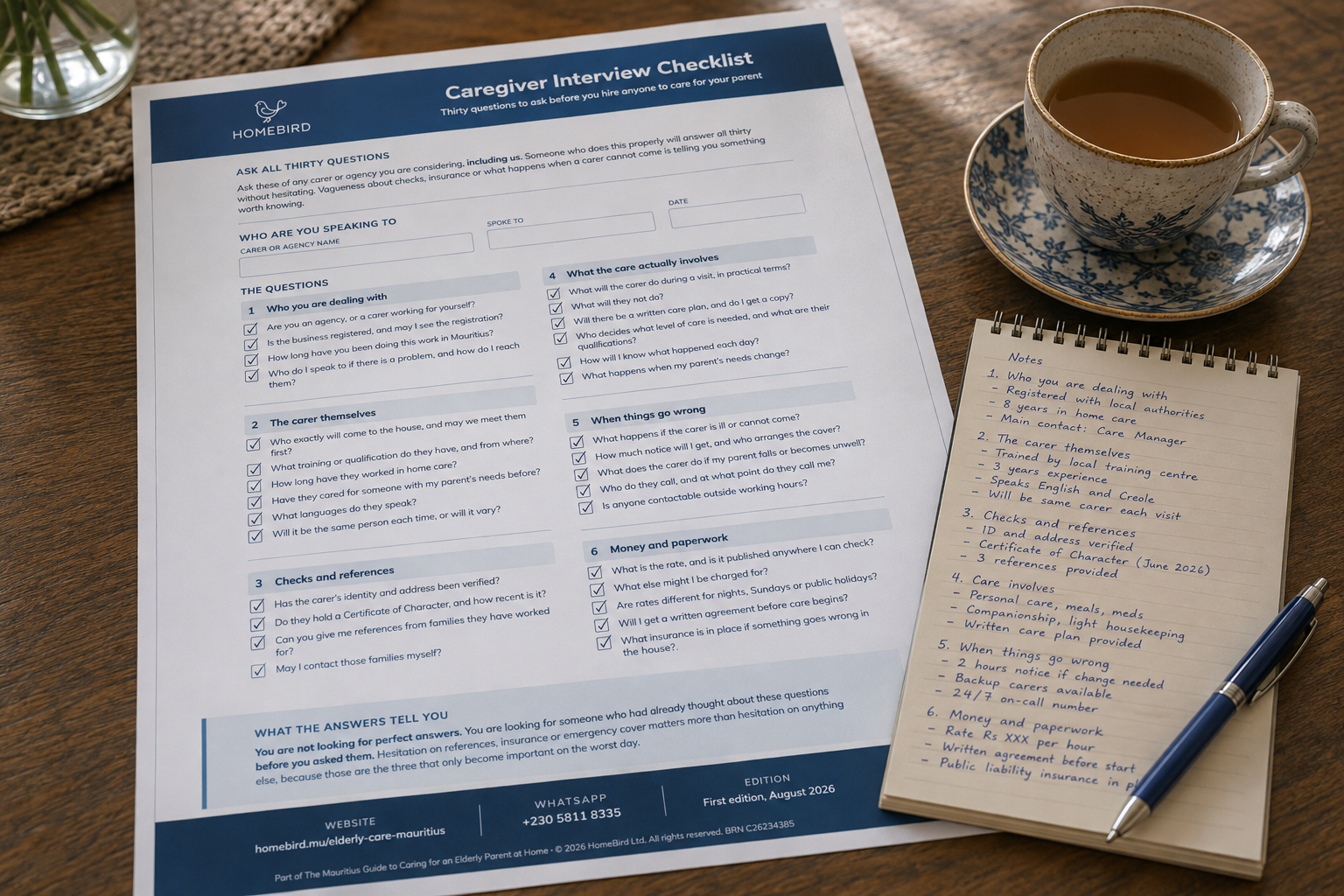
3. Checks and references
This is where families push least and should push most. Asking a warm, capable person to prove who they are feels rude. Ask anyway. Anyone who has worked professionally expects it and will not be offended, and in a community this size the request is more normal than it feels.
Ask whether identity and address have been verified, whether there is a current Certificate of Character, and whether you can speak to families they have worked for.
A good answer is specific about what has been checked and when, and offers references you can contact yourself rather than a testimonial someone else has written down.
What should give you pause is a reference you are not allowed to phone.
4. What the care actually involves
Ask what the carer will not do, and listen closely. Almost every dispute in home care comes from an assumption nobody wrote down: whether cleaning the whole house is included, whether the carer gives medication or only reminds, whether they will drive your mother to an appointment in Grand Baie.
Ask who decides the level of care as well. If the person assessing your parent's needs is also the person selling you the hours, and has no clinical background, that is worth knowing before you agree to anything.
A good answer includes a written care plan you get a copy of, a clear line between what is included and what is not, and a named person with relevant qualifications doing the assessment.
What should give you pause is anything agreed only verbally, or a quote arriving before anyone has visited the house.
5. When things go wrong
These five questions feel unnecessary right up until the morning they are the only ones that matter. A carer gets dengue. Your mother falls at seven on a Sunday evening. Somebody needs to know what happens next, and it should not be you working it out from Melbourne at two in the morning.
Ask what happens when the carer cannot come, how much notice you get, what the carer does if your parent falls or becomes unwell, who they call, at what point they call you, and whether anyone is contactable outside working hours.
A good answer describes a specific arrangement rather than a reassurance. Someone who has thought about this will tell you exactly who covers and how quickly.
What should give you pause is "that has never happened". It will.
6. Money and paperwork
Ask whether the rate is published anywhere you can check. In Mauritius it usually is not, which means the price you are quoted may not be the price the family down the road was quoted. Worth knowing before you negotiate rather than after.
Ask about insurance specifically. A carer works in your parent's home, moves them, handles their medication and is alone with them for hours. If something goes wrong, somebody carries that, and you should know who.
A good answer sets out the rate, what else you might be charged for, whether nights, Sundays and public holidays differ, and puts all of it in a written agreement before care begins.
What should give you pause is a rate that seems to depend on how you look, or a request to start on Monday and sort out the paperwork later.
You are not looking for perfect answers. You are looking for someone who had already thought about the question before you asked it.
What the answers actually tell you
You are not looking for thirty perfect answers. You are looking for someone who had already thought about these questions before you asked them, because that is what tells you whether there is a structure behind the person or only good intentions.
Good intentions are not nothing. A great deal of excellent care in Mauritius is given by people with no paperwork at all, and a family who hires that way with their eyes open, and plans for the gaps, can do very well. What you should not do is assume the structure is there without checking.
And if someone becomes uncomfortable when you ask about checks, insurance or what happens when a carer is ill, that discomfort is itself an answer.
Download the checklist
All thirty questions on one page, grouped as above, with space to write the answers as you go. Print it and take it with you. There is nothing to sign up for, and it works just as well on us as on anyone else.
If you would like to know what happens once you have chosen someone, we have written about what actually happens during a home care assessment.
This article is part of The Mauritius Guide to Caring for an Elderly Parent at Home, our free guide for families across the island. See the full guide.
Talk to Homebird
Homebird is a professional in-home care agency serving families across Northern Mauritius. If you would like to put these thirty questions to us, send a message and we will answer every one of them. No obligation, no pressure.
WhatsApp or call: +230 5811 8335
Email: hello@homebird.mu
Care that feels like family.
This article is for general information and is not a substitute for professional or legal advice.