
The hospital says Friday. It is Tuesday evening, your father is coming home with a walking frame and instructions nobody wrote down properly, and the house has not changed since he went in.
Or your mother is moving in with you next month, into a house that was built for a family with young children. Or she has just been widowed at seventy-eight and is about to live alone for the first time in fifty-one years, in a house she has always shared.
Preparing a home for an elderly parent is usually done under this kind of pressure rather than at leisure, and the good news is that most of what matters can be found in about half an hour and fixed in an afternoon.

Walk it the way they will use it
Do not start with a list. Start at the gate and walk in the way your parent will actually arrive, then follow the route of an ordinary day: front door, the chair they will sit in, kitchen, bathroom, bedroom, and finally the bedroom to bathroom route with the lights off.
That last one matters more than anything else on this page. Night-time journeys to the toilet are where a great many falls happen, and it is the only part of the house nobody ever inspects, because nobody is awake to see it.
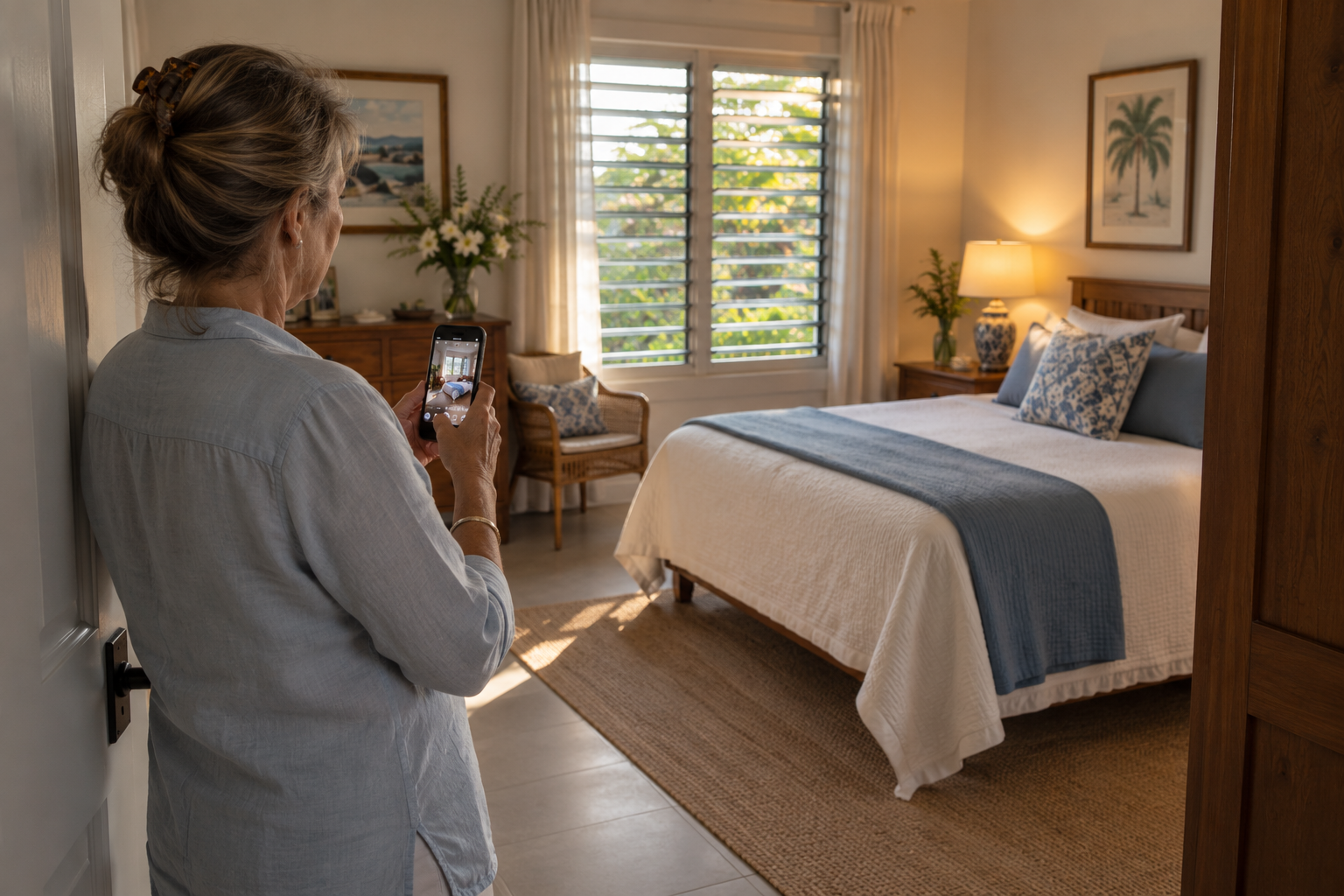
Take your phone and photograph anything that gives you pause. You will not remember it all, and if a sibling is helping from Australia the photographs are worth more than any description.
The six things that matter most
If you only have an afternoon, do these and leave the rest for later.
1. Light the night route. A working bulb or a plug-in night light between the bed and the bathroom, and a lamp or torch within arm's reach of the bed. Cheapest fix in the house and the one that prevents the most.
2. Clear the floor on that route. Loose mats, a fan cable, a box that has been there for years. It does not need to be tidy, it needs to be walkable in the dark.
3. One grab rail in the bathroom. Beside the shower, screwed into the wall rather than suction-cupped onto it, plus a non-slip mat. Polished tiles and water are the most dangerous few square metres in any Mauritian house.
4. Raise the chair. If your father cannot stand up without pulling on furniture, the chair is too low. A higher seat removes that risk many times a day and costs nothing if there is a suitable chair elsewhere in the house.
5. Put a phone within reach. Of the bed and of the chair they will spend the day in. Not in the hallway, which is where it has always been.
6. Move the everyday things down. Kitchen and bathroom. Nothing they use daily should require a stool, and no stool should be in reach to tempt them.
A night light and one grab rail fitted on Thursday are worth more than a perfect plan that starts in six weeks.
Fire, which almost nobody checks
Home safety advice concentrates on falls because falls are common. Fire is rarer and considerably worse, and it takes four minutes to look at.
Check the age of the gas cylinder hose and the regulator, and whether anyone can remember when either was last changed. Look at whether a mosquito coil is burning anywhere near bedding or curtains. Note whether candles are the plan for a power cut, because they should not be. And check whether there is a working smoke alarm, which in most Mauritian houses there is not.
If your parent is becoming forgetful, the hob is worth a moment's thought as well. A pot left on is the single most common way this goes wrong, and it usually starts long before anyone has used the word dementia.
If they are moving in with you
A house that works for a family with children is often wrong for someone in their eighties, and the mismatches are not the obvious ones.
Which floor. If the only bathroom is upstairs, that decides the bedroom, and a downstairs room that was a study is usually a better answer than a stairlift.
Somewhere to be that is not the bedroom. Someone who has run their own household for fifty years and now sits on the edge of somebody else's living room will retreat to their room and stay there. A chair that is genuinely theirs, in the room where life happens, matters more than the size of the bedroom.
Their own things. Their chair, their photographs, their radio, the pan they have always cooked with. A room furnished entirely from your house is a guest room, and people behave like guests in guest rooms.
Noise and routine. Grandchildren are a joy and also, at half past six in the morning, a considerable adjustment. Worth discussing before rather than after.

If they are about to be alone
This is the situation the checklists ignore, because nothing about the house has changed. Everything else has.
Someone newly widowed or newly alone has lost the person who noticed things: that she had not eaten, that he seemed unsteady, that something was wrong. That absence is a bigger risk than the bathroom floor and it will not show up in any inspection of the property.
Three things help. Someone who calls at the same time every day, so that a missed call means something. A neighbour who knows the situation and has a number for you. And, if the house is quiet for long stretches, someone coming in regularly, which is what companion care is for and the reason it is worth more than families expect.
Watch the first fortnight in particular. Meals, sleep and whether they are getting dressed at all are the three things that slip first.
The biggest risk to someone newly living alone is not the bathroom floor. It is that nobody is there to notice.
Coming home from hospital
Discharge deserves its own note, because the first week home is when readmissions happen.
Before Friday: get the discharge instructions in writing and read them, collect any new prescriptions rather than assuming they are in the bag, know who to ring at the weekend if something looks wrong, and make sure whatever equipment was mentioned has actually arrived. A walking frame promised on discharge and delivered the following Wednesday is a common and dangerous gap.
And be realistic about the first week. Someone who managed alone before a hip operation will not manage alone immediately after one, and that is temporary rather than permanent. Many families arrange help for a fortnight and then stop, which is exactly the right shape.
What can wait
Nearly everything else.
Widening doorways, a walk-in shower, rehanging doors, a stairlift. These matter eventually for some people and they are not what is going to go wrong this month. Families who treat preparing a house as a renovation usually do nothing for six weeks, which is worse than a night light and a rail fitted on Thursday.
Once the urgent part is done and you have time to do it properly, our home safety checklist is a free printable that walks the whole house room by room, including cyclone season.
This article is part of The Mauritius Guide to Caring for an Elderly Parent at Home, our free guide for families across the island. See the full guide.
Talk to Homebird
Homebird is a professional in-home care agency serving families across Northern Mauritius. If a parent is coming home from hospital or about to live alone and you would like a second pair of eyes on the house, send us a message. No obligation, no pressure.
WhatsApp or call: +230 5811 8335
Email: hello@homebird.mu
Care that feels like family.
This article is for general information and is not a substitute for professional medical advice. Follow the discharge instructions given by your parent's hospital or doctor.