
Loneliness in Later Life: Why It Happens, and Twenty Things That Help
Ask your father whether he is lonely and he will say no. Almost every man of that generation will, and a good many women too, because the word carries a weight nobody wants to pick up.
So ask a different question. When did he last have a proper conversation with somebody who is not family, not a doctor and not on a screen? For a lot of people in their eighties the honest answer is measured in weeks.
Loneliness in older people is one of the least visible things a family deals with, partly because it makes no noise and partly because the person experiencing it will rarely name it.
Two different problems
These get treated as one thing and they are not.
Social isolation is a matter of arithmetic. How many people someone actually sees and speaks to. It can be counted.
Loneliness is the distance between the connection someone has and the connection they want. It cannot be counted, and only they can tell you about it.
The two come apart more often than you would think. A man who sees almost nobody but is entirely content with his garden and the radio is isolated and not lonely. A woman living in a full house where everyone works late, and nobody has asked her a question in a fortnight, is surrounded and profoundly lonely.
This matters because the remedies are different. Isolation is solved by more contact. Loneliness is solved by better contact, and adding more people to a lonely person's week can miss entirely.
Isolation is how many people you see. Loneliness is the distance between the company you have and the company you want. A full house can be lonelier than an empty one.
Why it happens, and why it accelerates
Almost every cause is a loss, and they arrive in sequence rather than one at a time.
Work ends. Retirement removes a structure and a set of daily relationships in a single week, and most people underestimate how much of their social life was simply attached to going somewhere.
Friends die. By eighty this is relentless, and each one removes somebody irreplaceable, because you cannot make a friend of fifty years at eighty-one.
The car goes. The most underestimated of all. Giving up driving in Mauritius, where the bus is difficult and everything is twenty minutes away, ends most spontaneous social contact overnight.
Walking gets harder. Hips, knees, breath, a fear of falling. Places that were easy become an expedition.
A husband or wife dies. This is a category of its own. It removes the person they spoke to all day, and frequently the person who maintained the whole social network on both their behalves.
The children leave. In Mauritius this often means another country rather than another village, and it removes the grandchildren too.
Any one of these is manageable. Three or four within five years is what turns an ordinary life into a silent one, and it happens gradually enough that nobody notices the point at which it changed.
Two things imported advice gets wrong here
A full house is not the same as company. There is an assumption in Mauritius that extended family living means nobody is lonely, and it is not reliable. Someone can spend the day in a house where three generations come and go, every one of them working or studying or on a phone, and speak to nobody properly from morning until night. Living among people who are busy can be lonelier than living alone, because at least alone you are not reminded of it hourly.
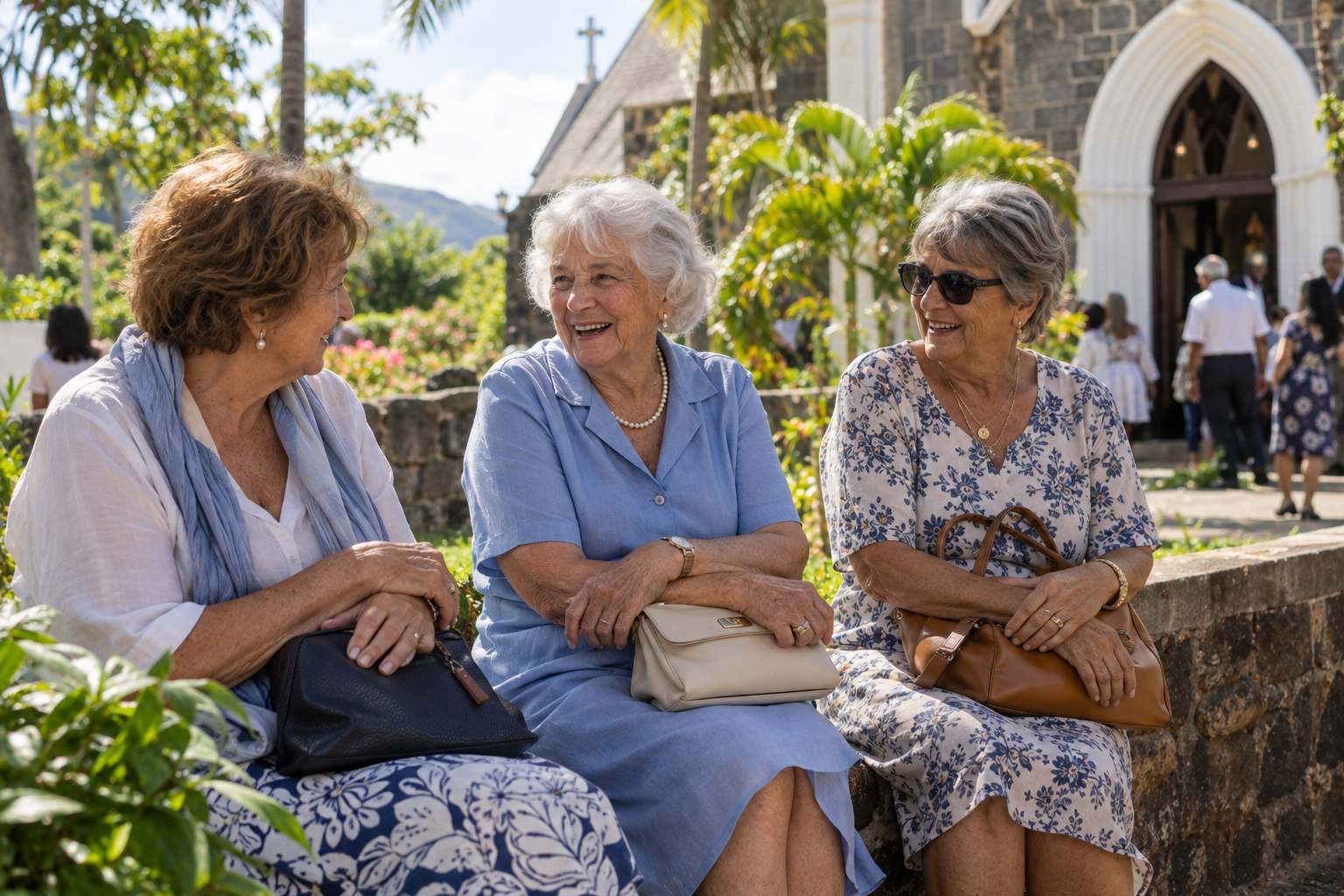
The place of worship is the most underused resource there is. Whatever the family's faith, the temple, church, kovil or mosque is already there, already familiar, costs nothing, runs on a schedule and is full of people of the same generation. For an older person who has stopped going because getting there became difficult, arranging a lift is frequently the single most effective thing a family can do, and it is more effective than anything else on the list below.
It is more common than families think
The World Health Organization set up a Commission on Social Connection, which reported in 2025 and found that around a third of people aged sixty and over worldwide are socially isolated, and that isolation and loneliness carry measurable effects on physical and mental health.
Two useful things follow. There is nothing unusual or shameful about your parent's situation, and it is worth saying that to them. And connection is not a nicety to be arranged once the practical needs are met. It belongs alongside them.
Twenty things that help
Do not attempt all of these. Pick two, make them regular, and let them become ordinary rather than an event.
Getting out of the house
Arrange a lift back to the temple, church, kovil or mosque. Start here.
Set one standing weekly outing, the same day and the same time. Predictability matters more than variety.
Go to the market, even when there is nothing to buy.
Book a regular appointment that is not medical. A hairdresser or barber every three weeks is a conversation as much as a haircut.
Put a chair outside the front of the house rather than inside it. In a Mauritian village that alone changes how many people say hello in a day.
Bringing people in
Find one reliable visitor rather than several occasional ones. Same person, same day.
Reconnect one old friend properly rather than trying to revive a whole address book.
Have the grandchildren do their homework at her table.
Introduce one neighbour deliberately, and give them your number.
Share a meal rather than pay a visit. Eating together is a different thing from sitting together.
Having a reason to get up
Something that depends on them. Plants, a few chickens, a cat.
Cooking for somebody else, even once a week.
Teaching something. A recipe nobody else in the family can make is a real thing to pass on.
Recording the family history. Give a grandchild a phone and an afternoon, and it becomes a project rather than an interview.
A job in the household that is genuinely theirs and not made up. People know the difference.
When you are not there
Call at the same time every day. A missed call then means something.
Short, frequent video calls with the grandchildren rather than long occasional ones.
A family WhatsApp group that carries photographs. Low effort, and it keeps them inside the daily life of the family.
Voice notes rather than typing, which most older people find far easier and warmer.
Send something in the post. A card or a photograph gets kept and looked at, which no message ever does.
Do not try twenty things. Pick two, make them regular, and let them become ordinary rather than an event.
When paid company is the honest answer
Sometimes the family is abroad, the friends have gone and the neighbours are working, and no amount of arranging fixes a Tuesday afternoon.
Someone coming in regularly is a reasonable answer to that, and it is worth more than families expect, partly because of the company itself and partly because a person who comes every week notices things that nobody on a phone call ever will. We have written about what that involves in companion care, including an honest answer to the feeling that paying someone for company is sad.
When it is not loneliness
Low mood in an older person is not always loneliness, and it is worth knowing the difference before arranging a full diary that solves nothing.
Loneliness tends to lift when the right company arrives. If your mother is flat or withdrawn even on the days when people come, if she has lost interest in things she always enjoyed, if she is sleeping or eating very differently, or if this has persisted for weeks rather than days, that is worth raising with her doctor. Depression in older people is common, it is frequently missed, and it is treatable.
Arranging more visits for someone who is depressed is not a solution and can leave a family concluding that nothing helps, when in fact the wrong thing was tried.
Start with one
Twenty ideas is twenty too many for a Sunday afternoon. Pick the one that would have been easiest five years ago and start there, which for most families is the lift to the temple or the church.
And ask her what she misses. Not what she needs, which invites a polite denial, but what she misses. The answer is usually specific, frequently surprising, and far more useful than anything on this list.
This article is part of The Mauritius Guide to Caring for an Elderly Parent at Home, our free guide for families across the island. See the full guide.
Talk to Homebird
Homebird is a professional in-home care agency serving families across Northern Mauritius. If your parent is managing perfectly well but seeing almost nobody, that is a reasonable thing to call about. No obligation, no pressure.
WhatsApp or call: +230 5811 8335
Email: hello@homebird.mu
Care that feels like family.
This article is for general information and is not a substitute for professional medical advice. If you are concerned about an older person's mood, speak to their doctor. Figures on social isolation are from the WHO Commission on Social Connection, 2025.