
It rarely arrives as one dramatic moment. It is usually something small. Your mother tells you the same story twice in one phone call. Your father, who has driven the Grand Baie coastal road for forty years, comes home flustered because he could not remember which turning to take. You put it down to tiredness, or age, or the heat. Then it happens again.

Most families we meet at Homebird did not arrive at our door after a crisis. They arrived after months of quietly wondering whether they were imagining things. If that is where you are right now, this article is written for you. It will help you tell the difference between ordinary forgetfulness and something that needs attention, and it will show you exactly what to do next.
First, the most important thing to understand
Dementia is not a normal part of getting older. This is the single most common misunderstanding we encounter, and it is the reason so many families wait too long before seeking help.
Ageing does change the brain. Older people often take a little longer to recall a name, or need more time to learn how to use a new phone. That is normal. Dementia is different. It is an umbrella term for a group of conditions that damage the brain and cause a steady decline in memory, thinking, language and judgement, severe enough to interfere with everyday life.
Alzheimer's disease is the most common cause. Vascular dementia, which is linked to problems with blood supply to the brain, is the second most common, and it matters a great deal here. Around one in five Mauritian adults lives with diabetes, and high blood pressure is widespread. Both are significant risk factors for vascular dementia. In practical terms, a parent in Goodlands or Triolet whose diabetes has been poorly controlled for years carries a higher risk than most people realise.
Normal ageing or early dementia? A simple comparison
The clearest test is not whether your parent forgets things. Everyone forgets things. The test is whether the forgetting is starting to interfere with daily life, and whether it is getting worse over months rather than staying steady over years.
Likely normal ageing
Forgetting an appointment now and then, but remembering it later
Worth investigating
Forgetting recently learned information repeatedly, and not recalling it even when reminded
Likely normal ageing
Occasionally struggling to find the right word
Worth investigating
Frequently stopping mid-sentence, or calling familiar objects by the wrong name, for example calling a watch "the hand clock"
Likely normal ageing
Misplacing keys or glasses and retracing steps to find them
Worth investigating
Putting things in unusual places, such as the kettle in the wardrobe, and being unable to retrace steps
Likely normal ageing
Needing help with a new or unfamiliar device
Worth investigating
Struggling with a task done for decades, such as cooking a familiar dish or managing the household bills
Likely normal ageing
Sometimes losing track of the day, then working it out
Worth investigating
Losing track of the season or the year, or becoming confused about where they are in a familiar place
Likely normal ageing
Making an occasional poor decision
Worth investigating
A noticeable change in judgement, such as giving away large sums of money or neglecting personal hygiene
Likely normal ageing
Feeling tired of work or social obligations from time to time
Worth investigating
Withdrawing from church, temple, family gatherings or hobbies that were once central to their life
The clue most families miss: with ordinary age-related forgetfulness, a prompt usually works. Remind your mother that her niece visited on Sunday and she will say "yes, of course." With early dementia, the memory often has not been stored at all, so the prompt does not bring it back. She is not being difficult. The event genuinely is not there.
The signs, one by one
Clinicians look for a recognised set of changes. Here is what each one actually looks like in a real household.
1. Memory loss that disrupts daily life
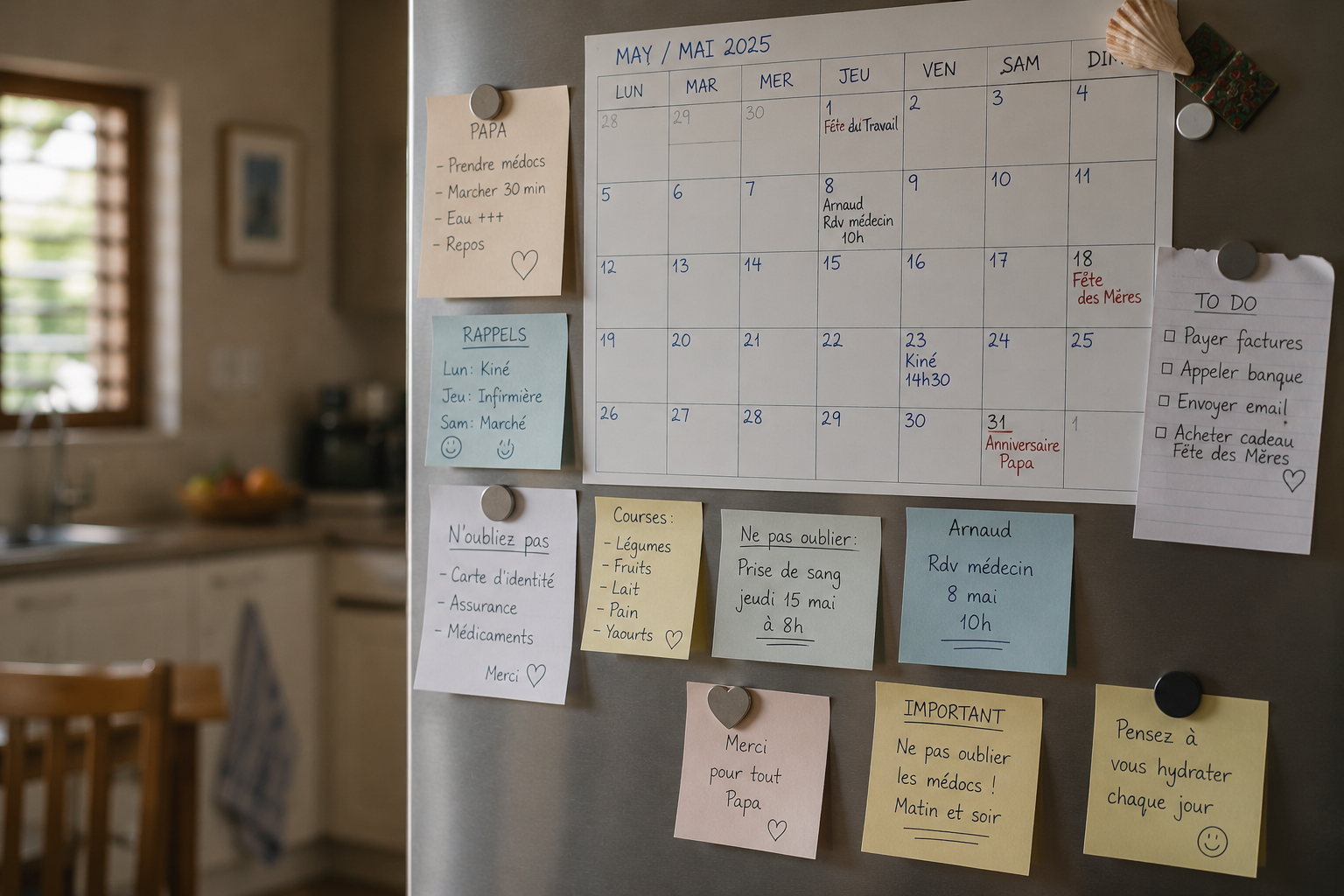
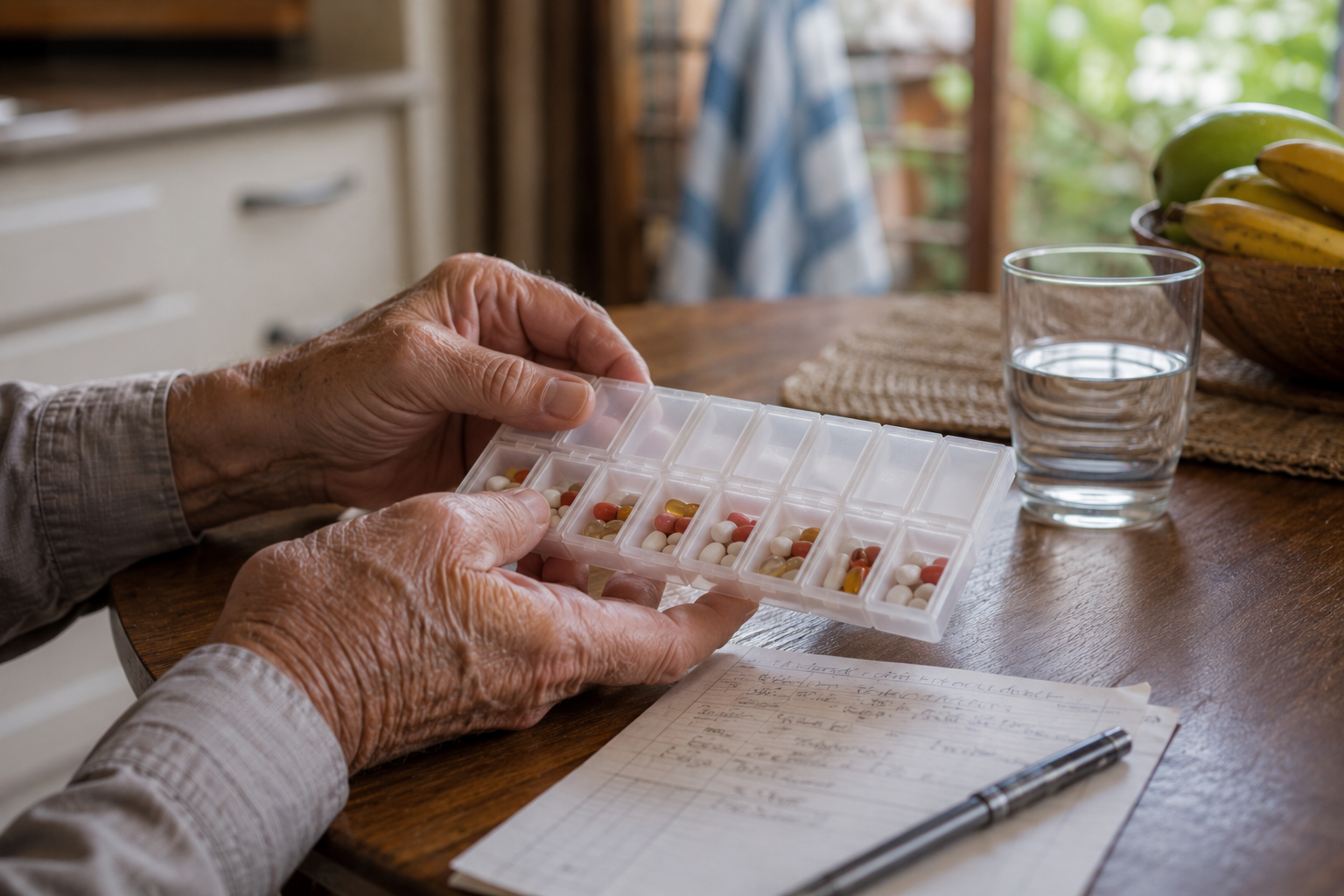
Not the occasional lapse, but a pattern. Asking the same question several times in an afternoon. Relying more and more on notes, or on you, for things they used to handle alone. Missing medication doses, which is often the first thing family members notice from a distance.
2. Difficulty planning or solving problems
A parent who always kept the household accounts starts making errors, or takes far longer over them. Following a familiar recipe becomes hard. Concentration slips.
3. Trouble with familiar tasks
This is often the moment a family stops explaining things away. Getting lost driving to Super U in Grand Baie. Being unable to work the gas hob. Forgetting the rules of a card game or a domino game they have played every week for years.
4. Confusion with time or place
Losing track of dates and seasons. Struggling to understand something that is not happening right now. Occasionally, forgetting how they got somewhere. A parent may be found walking near Pereybère or Cap Malheureux with no clear idea of how they arrived.
5. Problems with vision and spatial awareness
This is separate from ordinary cataracts or long-sightedness. Difficulty judging distance, misreading steps, or trouble telling colours apart. It is a common contributor to falls at home.
6. New problems with words
In a country where many families move between Creole, French and English in a single conversation, this one is easy to overlook. Watch for a parent who increasingly drops back to only their mother tongue, loses the thread mid-sentence, or repeats themselves within the same conversation.
7. Misplacing things and losing the ability to retrace steps
Items turning up in strange places. Importantly, this can be accompanied by accusations of theft against family members or domestic help. This is a symptom of the illness, not a judgement of anyone's character, and it is one of the most painful things for a family to sit with.
8. Decreased or poor judgement
Falling for a telephone scam. Giving money away. Wearing heavy clothing in January heat. Letting personal grooming slide when they were always immaculate.
9. Withdrawal from work and social life
Pulling back from the temple, the church, the mosque, the market, the neighbourhood group. Often this happens because keeping up with conversation has become exhausting, and withdrawing feels safer than being embarrassed.
10. Changes in mood and personality
Confusion, suspicion, anxiety, or irritability, particularly when they are out of their usual routine or environment. A gentle parent who becomes sharp, or a sociable one who becomes fearful.
Before you assume the worst
This part matters, and it is the reason we always urge families to see a doctor rather than reaching a conclusion at home. Several conditions cause symptoms that look very much like dementia but are treatable, and sometimes fully reversible:
Urinary tract infections. In older people these frequently cause sudden confusion, disorientation and agitation. If the change appeared over days rather than months, this is a leading suspect.
Vitamin B12 deficiency and thyroid problems. Both affect memory and concentration, and both are corrected with straightforward treatment.
Depression. Very common after the loss of a spouse, and easily mistaken for dementia because it slows thinking and dulls interest in everything.
Medication side effects. An elderly parent may be taking several medicines from several prescribers. Sedatives and some blood pressure drugs can cause significant fogginess.
Dehydration. Genuinely common in the Mauritian climate, especially in older people whose sense of thirst has diminished.
A sudden change over hours or days points towards one of these. A gradual decline over six months or more is more consistent with dementia. Either way, the answer is a medical assessment, not guesswork.
What to do next: four practical steps
Step one: write it down
Start a simple diary today. Note the date, what happened, and how your parent reacted. Three weeks of specific written examples will be worth more to a doctor than an hour of "she has not been herself lately." Ask your siblings, and anyone who helps in the home, to add what they have noticed. Families are often astonished at how much the record reveals once it is on paper.
Step two: see a doctor
Start with the family GP or the nearest Area Health Centre. Public specialist services in the north are accessed through Sir Seewoosagur Ramgoolam National Hospital at Pamplemousses, which is the referral hospital for the Pamplemousses and Rivière du Rempart districts covering Grand Baie, Goodlands, Triolet and the surrounding villages. Private options are also available in and around Grand Baie. Bring your diary and a full list of current medications, including anything bought without a prescription.
Step three: get support for yourself
The Association Alzheimer & Dementia Mauritius is a registered NGO offering information, counselling and family support, with a multidisciplinary team including psychologists and speech therapists. At the time of writing they can be reached on +230 696 3531, Monday to Friday. You do not need a confirmed diagnosis to contact them.
Step four: think about the home, early
Small, unglamorous changes make an enormous difference and are far easier to introduce while your parent can still take part in the decision. Improve lighting in corridors and on stairs. Remove loose rugs and trailing cables. Fit grab rails in the bathroom. Put a large, clear clock showing the day and date somewhere central. Label key cupboards. Keep routines and furniture consistent, because familiarity is genuinely protective.
What not to do
Do not argue or correct constantly. If your father insists it is Tuesday when it is Thursday, and nothing depends on it, let it go. Winning the point costs you both far more than it gains.
Do not test them."Who am I? What did you have for lunch?" feels like care, but lands as humiliation.
Do not wait for certainty before acting. Early assessment opens doors: treatable causes can be found, medication may help, and above all your family gets time to plan while your parent can still express what they want.
Do not try to carry it alone.The adult child who quietly absorbs everything, usually the daughter, usually the one who lives closest, is the person most likely to burn out. That helps nobody.
How home care helps at this stage
Families often assume care is something you arrange at the end, when a parent can no longer manage at all. In our experience the opposite is true. Support introduced early, while a parent is still largely independent, works better and is accepted more willingly, because a carer arriving now is a companion rather than a stranger who appeared during a crisis.
In the early stage, that support usually looks modest. A few hours of companionship two or three times a week. Someone to keep an eye on medication. A walk, a conversation, a shared meal. A trained pair of eyes noticing the changes you cannot see from Port Louis or from overseas, and telling you about them honestly.
Familiarity is one of the strongest tools in dementia care, and it is the reason we place great weight on continuity. The same carer, in the same home, on the same days, keeping the routines your parent already knows. For families across Grand Baie, Pereybère, Cap Malheureux, Grand Gaube, Goodlands and Petit Raffray, that consistency is often what allows a parent to stay in their own home safely for far longer.
This article is part of The Mauritius Guide to Caring for an Elderly Parent at Home, our free guide for families across the island. See the full guide.

Talk to Homebird
Homebird is a professional in-home care agency serving families across Northern Mauritius. Our carers are trained, verified and supported, and we build care around the person rather than around a rota. If you are worried about a parent and are not sure what you need yet, that is exactly the right time to talk to us.
WhatsApp or call: +230 5811 8335
Email: hello@homebird.mu
Care that feels like family.
This article is for general information and does not replace medical advice. If you are concerned about a family member, please speak to a doctor. Sources include the Alzheimer's Society, Alzheimer's Association, the NHS, Alzheimer's Disease International and the International Diabetes Federation.